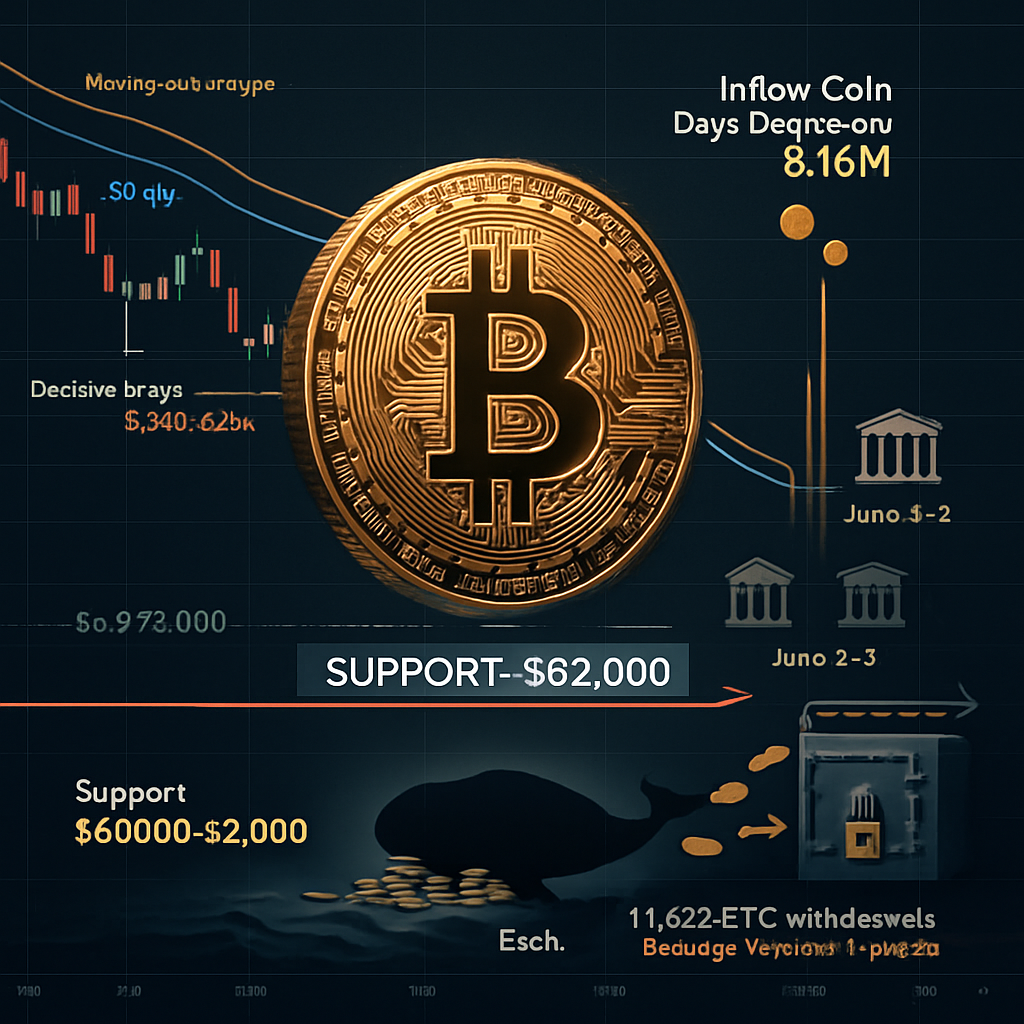
Bitcoin slipped below $62,000 this week amid elevated selling pressure and risk aversion, yet new on-chain data suggests large holders accumulated at the recent lows. Analysis from CryptoQuant contributor Woominkyu indicates whales were active around $60,000–$61,000 and subsequently moved holdings off exchanges, draining liquid supply even as price action remained fragile.
On-chain sequence: old coins moved, then whales stepped in
According to Woominkyu’s review of network flows, the downturn began after a spike in long-dormant coins hitting exchanges on June 2–3. The Inflow Coin Days Destroyed metric peaked at 2.16 million during that window, signaling that older, previously inactive holdings were transferred toward trading venues. That supply shock coincided with a slide from roughly $71,000.
At the local bottom near $60,000–$61,000, the Exchange Whale Ratio climbed to 61.6%, indicating a high share of large-holder participation during the most intense phase of the move. The analysis suggests that while retail sold into weakness, larger entities accumulated into the decline.
Post-bottom withdrawals signal supply drain
In the five days following the $60,000–$61,000 trough, approximately 11,422 BTC (about $700 million at the time) were withdrawn from exchanges, Woominkyu noted. Exchange Netflow turned sharply negative as coins accumulated during the selloff moved to cold storage, reducing the immediately available sell-side supply.
The pattern—buying into panic followed by rapid withdrawals—indicates that the $60,000–$61,000 area acted as a key accumulation zone for larger market participants, according to the analysis. While not a guarantee of near-term price strength, the behavior points to a near-term tightening of liquid supply.
Technical picture: retest of February support
Bitcoin last traded near $61,400 after a decisive break below the $64,000–$66,000 band that served as support during the February–March consolidation. The spot price is currently beneath the 50-day, 100-day, and 200-day moving averages, all of which are trending lower—evidence that bearish momentum remains dominant across multiple timeframes.
The $60,000–$62,000 range now represents a key support zone. Holding above it could allow price to stabilize and form a base; a clear breakdown would leave limited historical support until lower levels, raising the risk of another volatility expansion. As on-chain flows tighten liquid supply, traders will watch whether that backdrop offsets the prevailing technical weakness.
Data sources: CryptoQuant (on-chain metrics) and TradingView (price and trend indicators).