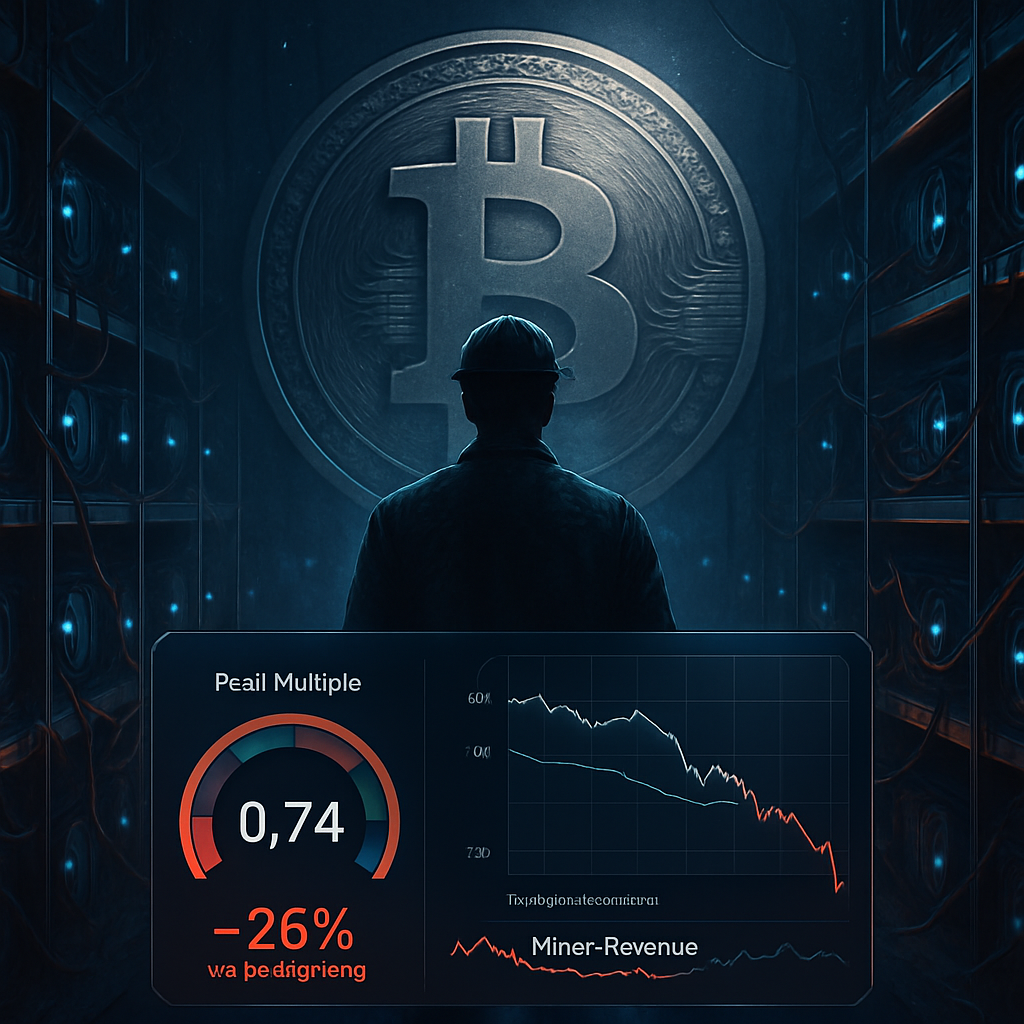
Bitcoin’s Puell Multiple, a key on-chain metric tracking miner revenue relative to its long-term average, has fallen to 0.74, suggesting miner earnings are currently below the past year’s norm. The move, highlighted by CryptoQuant analyst Axel Adler Jr. in a post on X, may signal growing revenue pressure on miners following recent market conditions.
What the Puell Multiple Measures
The Puell Multiple compares the USD value of daily Bitcoin issuance (newly mined BTC multiplied by the spot price) to its 365-day moving average. Lower readings indicate miner income is subdued versus the prior year, while higher readings point to elevated revenue conditions.
Latest Reading and Context
The indicator’s drop to 0.74 places miner revenue roughly 26% below its 12-month average. Such declines can occur when prices soften, network issuance falls, or both. With Bitcoin’s block subsidy reduced by the most recent halving cycle, miners are more sensitive to price and fee dynamics; if spot prices or transaction fees do not fully offset the lower subsidy, the Puell Multiple tends to compress.
Why It Matters
- Miner stress risk: Sustained revenue pressure can challenge higher-cost operators, potentially leading to machine shutdowns, consolidation, or changes in selling behavior.
- Market signaling: Historically, depressed Puell readings have aligned with phases of miner capitulation or post-stress recovery, though the signal is not deterministic and should be used alongside other metrics.
- Network dynamics: Extended revenue weakness may influence hash rate trends and difficulty adjustments as miners optimize operations.
What to Watch
- Hash rate and difficulty: Persistent declines in miner revenue could reflect in hash rate slippage or slower growth, feeding into difficulty adjustments.
- Miner balances and flows: Changes in miner-held BTC and transfer activity to exchanges can hint at stress or strategic selling.
- Transaction fees: Elevated fees can partially offset subsidy cuts, supporting miner income and the Puell Multiple.
While a reading of 0.74 underscores below-average miner revenue, the broader market impact depends on whether the trend persists and how miners respond through operational adjustments, holdings management, and capital strategies.