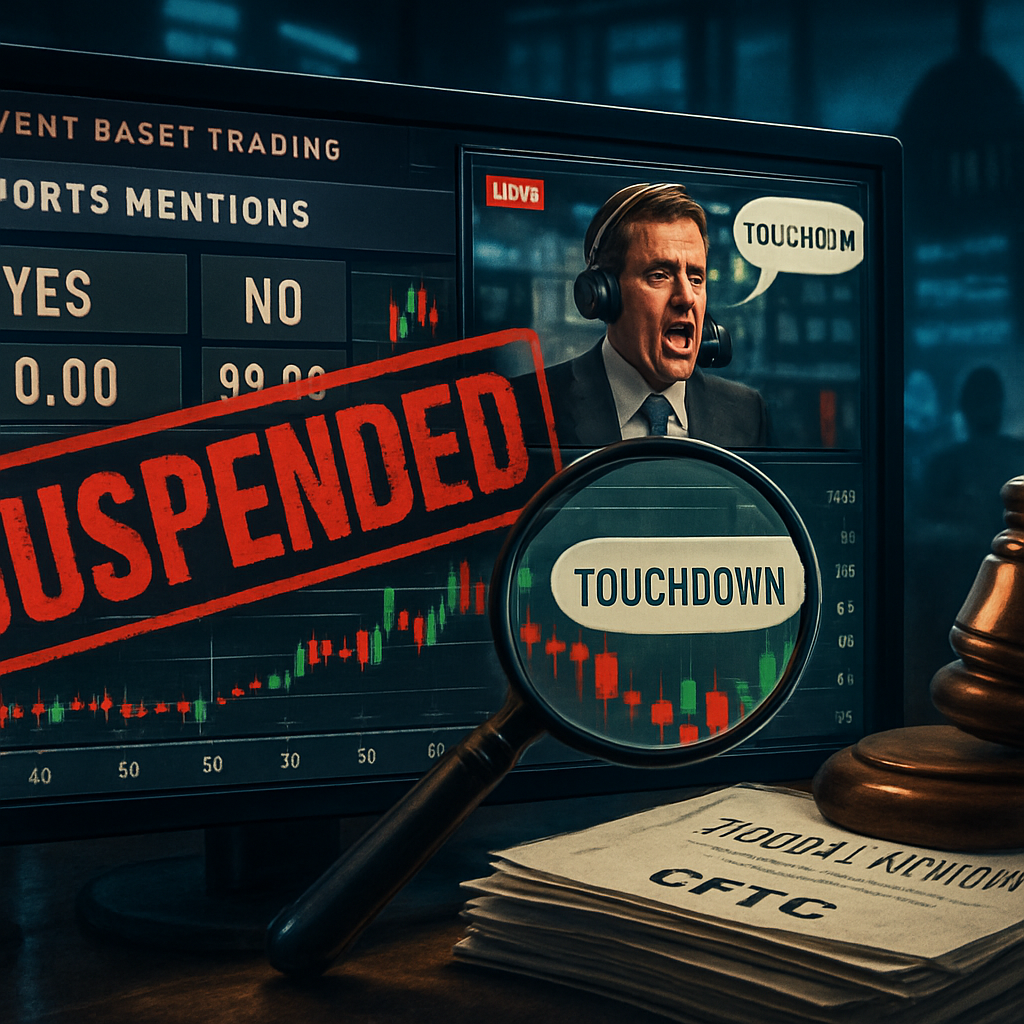
Kalshi has suspended all “sports-mention” markets while the U.S. Commodity Futures Trading Commission (CFTC) examines whether the category is vulnerable to manipulation, according to an NPR report citing anonymous sources. Markets tied to mentions on politics, corporate earnings calls, and news broadcasts remain available on the platform.
Regulatory Review Targets Sports-Mention Contracts
The review focuses on contracts that pay out based on whether a broadcaster says a specific word or phrase during a sports telecast. Regulators are assessing whether these markets are “readily susceptible to manipulation,” a core standard the CFTC applies when evaluating event contracts on designated contract markets.
Kalshi, a federally regulated exchange overseen by the CFTC, lists event contracts that allow users to trade on outcomes across economics, politics, and media. The sports-mention contracts have been pulled as the agency weighs whether the format could be influenced by a small number of participants or by actions unrelated to organic market forces.
What Are “Mention” Markets?
“Mention” markets are binary event contracts that resolve to “yes” or “no” depending on whether a named broadcaster or program utters a specified word within a defined time window. Because the outcome can hinge on real-time editorial decisions, the structure can raise questions about inducement or coordination and whether the event is sufficiently outside the control of traders.
According to the NPR report, Kalshi’s mention markets tied to political figures, earnings calls, and general news broadcasts continue to trade. Only the sports-specific mentions have been removed during the review.
Why It Matters for Event and Prediction Markets
The CFTC’s scrutiny underscores the agency’s broader mandate to prevent manipulation and protect market integrity as event contracts evolve. While Kalshi operates under existing derivatives regulations, the line between permissible event-based trading and impermissible or easily influenced outcomes remains an active area of oversight.
The outcome of the review could shape how exchanges structure future media-related markets—particularly those where a limited set of decision-makers or on-air talent can directly determine results. Any regulatory guidance or action may influence how platforms design contracts to mitigate manipulation risks and maintain compliance.
What’s Next
Neither Kalshi nor the CFTC’s staff comments were cited in the NPR report. It remains unclear whether the agency will require changes to existing market designs, impose new limitations on mention markets, or allow the paused contracts to return in their prior form. For now, trading continues in other mention categories as the regulated exchange awaits the outcome of the CFTC’s review.