Bitmine Buys Ethereum’s Largest 2026 Purchase, Tom Lee Dismisses Selloff

Bitmine Immersion Technologies expanded its Ethereum holdings during last week’s market sell-off, acquiring 126,971 ETH for roughly $214 million and marking its largest purchase of 2026 so far. The company now holds 5.54 million ETH, or about 4.59% of the total supply, and aims to reach 5% sometime in 2026, it said.

Largest 2026 Buy and Treasury Breakdown

Bitmine, which describes itself as the world’s largest Ethereum treasury, disclosed on Monday that it bought 126,971 ETH during the recent price dip that sent Ether to a one-year low of $1,505 on Sunday. At current prices, the firm said its combined crypto and cash holdings total approximately $9.6 billion. That figure includes:

  • 5,543,872 ETH (valued by the company at about $1,630 per ETH)
  • 204 BTC
  • A $180 million stake in Beast Industries
  • An $88 million stake in Eightco Holdings via its “Moonshots” initiative
  • $247 million in cash

“Buying the Dip” Rationale

Chairman Tom Lee said the firm accelerated purchases because it views the pullback as disconnected from Ethereum’s underlying fundamentals.

“We increased our buying as we believe this pullback in ETH prices does not reflect the strengthening of Ethereum fundamentals. This is not surprising given we are in the early stages of crypto spring,” Lee said.

Lee characterized the broader crypto sell-off as driven by short-term panic rather than structural weakness. He also argued that recent security issues elsewhere in the crypto ecosystem — referencing a Zcash Orchard incident — highlight the need for “hardened and reliable decentralized blockchains like Ethereum,” adding that advances in AI will expose flaws in centralized rails and weaker protocols. “Therefore, ETH prices should not be coming under pressure,” he said.

Supply Target and Market Context

Following the latest purchase, Bitmine estimates its ETH holdings represent about 4.59% of Ether’s circulating supply. The company expects to meet its 5% supply target in 2026, depending on market conditions and issuance dynamics. Large, price-insensitive treasuries can influence available float and liquidity, potentially affecting market structure during periods of stress or recovery.

ETH Technical Levels in Focus

Despite renewed accumulation from Bitmine, Ethereum has struggled in recent sessions. The second-largest cryptocurrency by market capitalization fell roughly 15% over the past week, losing the 200-week moving average near $2,471 and revisiting the $1,500 area.

Market observer Ash Crypto noted that ETH is repeating a setup seen during the last bear market. In June 2022, ETH broke through multiple support levels before bottoming near $880, a move that preceded a multi-quarter recovery. He suggested $1,500 is the next key support to watch; holding that level could mirror the prior cycle’s rebound, while a weekly close below it could open a move toward the $1,000 area where the next major support zone sits.

As of press time, ETH is trading around $1,687, up approximately 4.8% over the past 24 hours.

Bitcoin Nears $90K as Binance Buyer Surge Sparks Fresh Rally

Wellermen Image

Bitcoin Buyers Flood Binance as $90K Target Looms

Bitcoin is showing fresh signs of strength after on-exchange data revealed aggressive buying volumes on Binance, pushing the market closer to the long-awaited $90,000 level. The surge in buyer dominance suggests that demand is outpacing selling pressure, a classic setup that often precedes sharp upside moves.

The catalyst appears to be renewed conviction among spot buyers rather than leveraged speculation. Binance order flow data shows aggressive bids absorbing sell orders at a faster clip, a pattern that historically aligns with institutional accumulation phases. With Bitcoin already trading near all-time highs, this buyer-heavy volume is adding fuel to the narrative that the next leg higher could be decisive.

Traders who have been waiting on the sidelines are now forced to reassess. Those who missed the run from $60K to current levels face the risk of chasing if momentum accelerates, while holders who bought earlier are seeing their conviction rewarded. The key question now is whether this buying pressure can sustain once price tags the psychological $90K mark.

What This Means for Crypto

Buyer dominance on a major exchange like Binance often signals that spot demand is real rather than driven by temporary derivatives flows. This reduces the chance of a quick reversal and suggests that dips are being bought rather than sold into.

For long-term investors, the data reinforces the case that Bitcoin’s primary trend remains upward even as volatility persists. Builders and projects tied to the Bitcoin ecosystem may also benefit from the increased attention and capital rotation that typically follows these momentum bursts.

Market Impact and Next Moves

Short-term sentiment looks bullish as long as Binance buyer volumes remain elevated, though any sudden drop in aggressive bids could trigger a fast shakeout. The biggest near-term risk is a classic “buy the rumor, sell the news” reaction once price actually touches $90K.

Opportunity lies in any healthy pullback that clears weak hands before the next push. If Bitcoin can hold above recent support while buyer pressure stays strong, the path to new highs becomes much clearer.

Watch the bids, not just the price — when aggressive buying dries up, the story changes fast.

Bitcoin Quantum Risk: 3–5 Year Window to Migrate, Bernstein Says

Wellermen Image

Bitcoin Has Years to Fix Quantum Risk, Says Bernstein

Quantum computers that could break Bitcoin’s cryptography remain years away, but the threat is already prompting analysts to separate real risk from headline panic. Bernstein’s latest note argues that the danger sits mostly in old, untouched wallets and exposed public keys rather than the active network itself.

The firm points out that roughly 20 percent of Bitcoin’s supply sits in addresses whose public keys are visible on-chain, making them theoretical targets once large-scale quantum machines arrive. Newer wallets using modern address formats keep public keys hidden until coins move, shrinking the attack surface dramatically. Bernstein estimates the industry still has a three-to-five-year window to migrate vulnerable holdings before quantum hardware becomes a credible threat.

Who stands to lose most? Holders of dormant early-mined coins who never moved funds after 2010 sit at the front of the line. Exchanges and custodians that already enforce best-practice key hygiene face far less pressure. The bigger question is whether the Bitcoin community can coordinate a soft-fork or wallet-upgrade cycle before any single actor demonstrates quantum supremacy against elliptic-curve signatures.

What This Means for Crypto

Quantum risk sounds exotic, but it boils down to whether future machines can solve the math problem that protects private keys. A successful attack would let an adversary derive a private key from a visible public key and steal coins without needing passwords or seed phrases.

For everyday traders the immediate takeaway is simple: move older coins to fresh addresses that never reuse public keys. Long-term holders and institutions should start factoring quantum-migration roadmaps into custody decisions now rather than waiting for an emergency hard fork.

Market Impact and Next Moves

Short-term sentiment stays largely neutral; the Bernstein timeline removes any sense of imminent panic. Liquidity and leverage markets are unlikely to price in a quantum premium until hardware milestones appear on public roadmaps.

The real risk lies in complacency. If developers delay address-format upgrades or wallet vendors ignore migration tooling, the window could close faster than expected. On the opportunity side, projects shipping quantum-resistant signature schemes early could capture narrative alpha and developer mindshare.

Watch custody providers and Layer-2 teams for concrete upgrade timelines; the first credible quantum hardware demo will likely trigger the real repricing event, not today’s research headlines.

Zcash Crashed 50% on a Four-Year Secret; Recovery Quietly Begins

Zcash has completed a two-phase emergency upgrade to fix a critical flaw in its Orchard shielded pool, a vulnerability that went undetected for four years and could have enabled unlimited undetectable counterfeit ZEC within the pool. The swift response stabilized the network and helped reverse a sharp sell-off that saw ZEC’s price fall by roughly 50% before beginning to recover.

How the Vulnerability Was Discovered

The issue was identified on May 29, 2026, by security researcher Taylor Hornby during a protocol audit commissioned by Shielded Labs. According to the organization’s disclosure, Hornby found a “soundness” bug in Zcash’s Orchard zero-knowledge proof circuit—specifically, an under-constrained component in the Orchard Action circuit that could allow invalid state transitions and the theoretical creation of undetectable counterfeit ZEC within the shielded pool. Shielded Labs said the discovery was aided by a custom analysis suite and an AI model, and that Hornby produced a working proof-of-concept in a local test environment.

While the bug was severe in theory, Zcash’s internal turnstile accounting—which tracks value moving into and out of the shielded pool—showed no evidence of unauthorized value creation on the live network, according to Shielded Labs. However, because of Orchard’s privacy properties and the nature of the flaw, the group acknowledged there is no definitive cryptographic method to determine whether the vulnerability was exploited before the fix. The flaw had been present since Orchard’s activation in May 2022.

Emergency Response and Network Fix

Zcash’s developers moved quickly with a two-step remediation. First, an emergency soft fork via Zebra 4.5.3 was activated at block 3,363,426 on June 2, temporarily disabling all Orchard transactions to remove the attack vector while a permanent patch was finalized. Transparent and Sapling transactions continued uninterrupted, according to the Zcash Foundation.

The permanent fix arrived with the NU6.2 hard fork at block 3,364,600 on June 3, deployed via Zebra 5.0.0. This upgrade introduced a corrected circuit and a new verifying key, patching the flaw and re-enabling Orchard transactions. Josh Swihart, CEO of Electric Coin Company, later posted on June 7 that the fix was complete and the network secure.

Market Impact and Recovery

The incident triggered extreme volatility. ZEC rose from $544 on June 2 to $603 on June 3 and reached $624 on June 4 before plunging to $309 on June 5, a drawdown that erased more than $3 billion in market value, according to a timeline compiled by the BitMEX Blog. Sentiment was further pressured on June 4 when Arthur Hayes said he had exited his ZEC position, citing macro considerations.

Swihart’s June 7 update, along with transparent disclosures from Shielded Labs and the Zcash Foundation, helped restore confidence. As of publication, ZEC traded around $430, recovering from the lows recorded after the vulnerability’s disclosure, according to TradingView data.

What It Means for Zcash

The swift, coordinated response across the Zcash ecosystem contained a high-severity risk and restored core functionality to the Orchard shielded pool. At the same time, the episode underscores a long-standing challenge for privacy-focused cryptocurrencies: the same features that protect user privacy can complicate forensic verification when assessing potential exploits. Going forward, Zcash’s developers and community face the task of reinforcing assurance around shielded pools while maintaining the project’s privacy guarantees.

SEC Names New Crypto Enforcement Chief as Dropped Cases Spark Questions

Wellermen Image

SEC Picks New Crypto Cop as Old Cases Vanish

The Securities and Exchange Commission has named David Woodcock as its new enforcement chief, stepping in at a moment when the agency is quietly walking away from several high-profile crypto lawsuits. Senators are already pressing for answers about why cases against Justin Sun and other crypto firms were dropped without clear explanation. The timing raises fresh questions about whether enforcement priorities are shifting or simply cooling off.

Woodcock’s appointment comes as the SEC closes or pauses actions against Sun’s Tron network and other digital asset projects that were once labeled unregistered securities offerings. The agency offered little public detail on the decisions, fueling speculation that political pressure or internal reviews played a role. Lawmakers on both sides of the aisle now want a full accounting before the new chief takes full control of the division.

Investors and founders watching the space see this as another signal that the aggressive enforcement era may be winding down. For projects that survived years of legal uncertainty, the dropped cases remove immediate overhang and could unlock fresh capital and partnerships. Yet the lack of transparency also leaves markets guessing whether this is a lasting policy change or just a temporary pause.

What This Means for Crypto

The shift matters because enforcement actions have been the main regulatory tool shaping crypto in the United States. When the SEC drops suits, it reduces legal risk for tokens and exchanges that were previously in the crosshairs. Builders gain breathing room to ship products without fearing surprise lawsuits, while traders can price assets with less fear of sudden delistings or freezes.

For everyday investors, clearer enforcement direction means better visibility into which projects carry real regulatory risk and which ones may finally move from gray-area speculation to mainstream adoption. The change does not eliminate oversight, but it could tilt the balance toward more predictable rules rather than case-by-case attacks.

Market Impact and Next Moves

Short-term sentiment looks mildly bullish for tokens that were under active SEC scrutiny, as the removal of litigation risk often triggers quick rebounds in price and volume. Liquidity should improve as exchanges face less pressure to delist names tied to ongoing cases. Still, the opacity around why cases were dropped introduces new political and regulatory risks that could reverse quickly if leadership or congressional pressure changes.

The bigger opportunity sits with projects that have strong fundamentals and clean compliance records. With enforcement energy possibly redirected, capital may rotate toward infrastructure and real-world use cases that were previously overshadowed by headline risk. Traders should watch for any follow-up statements from Woodcock or the Senate that clarify the new enforcement stance before assuming the coast is clear.

Watch the next enforcement speech from the new chief — it will tell you whether this is a real pivot or just a quiet reset before the next round of fights.

OpenAI Files for U.S. IPO (Confidential)

OpenAI said it has confidentially submitted paperwork for a U.S. initial public offering, with the timing and size of the offering yet to be determined.

Filing details

The company disclosed that it filed a draft registration statement with U.S. regulators, a step that allows firms to begin the IPO process without immediately releasing full financials. Confidential submissions are reviewed by the Securities and Exchange Commission before a public filing is made.

Why it matters for crypto

While OpenAI is not a crypto company, developments in leading artificial intelligence firms have influenced digital asset markets tied to the AI theme. Investor interest in AI infrastructure and tooling has previously coincided with higher trading volumes in AI-related tokens. Notably, OpenAI CEO Sam Altman is a co-founder of Worldcoin (WLD), a separate project focused on digital identity and token distribution; there is no corporate affiliation between Worldcoin and OpenAI.

What to watch next

  • SEC review and any subsequent public registration statement.
  • Further details on offering size, valuation, exchange listing, and ticker symbol.
  • Potential spillover effects in AI-linked crypto assets and broader tech markets.

Zcash Surges 30% on Ceasefire Hopes, But Traders Brace for 40% Pullback

Wellermen Image

Zcash Surges 30% on Ceasefire Hopes, but Trap Looms

Zcash (ZEC) ripped higher by roughly 30% as news broke of a potential US–Iran ceasefire, riding a sudden wave of risk-on sentiment across crypto. The move echoed sharp bounces seen in the 2021 bear market, when price spikes quickly reversed into deeper losses. Traders are now watching whether this rally is the start of a sustained recovery or just another bull trap.

The spark came from macro headlines rather than any Zcash-specific upgrade or adoption news. Renewed diplomatic chatter between Washington and Tehran eased some geopolitical tension, pushing traders into higher-beta assets. ZEC, with its privacy focus and historically volatile price action, became one of the first tokens to catch a bid as liquidity returned to altcoin markets.

Technically, the token’s chart still shows the same pattern that preceded the 2021 drawdowns: a fast vertical move on thin volume followed by fading momentum. If history repeats, a 40% retracement could unfold within weeks as late buyers get shaken out. On-chain data also shows increased exchange inflows, hinting that some holders are already looking to sell into strength.

What This Means for Crypto

Zcash’s privacy features remain technically strong, yet price action is still driven more by macro sentiment and speculative flows than by actual usage growth. Traders treating the token as a geopolitical hedge should understand that liquidity can vanish quickly when the narrative shifts.

Long-term holders betting on regulatory clarity around privacy coins face an added layer of risk: any renewed enforcement focus on mixing or shielded transactions could cap upside even if broader markets recover. Builders, meanwhile, continue shipping upgrades, but those improvements rarely move price without a favorable macro backdrop.

Market Impact and Next Moves

Short-term sentiment looks mixed at best. The ceasefire-driven rally brought in momentum traders, yet the lack of follow-through volume suggests many are ready to flip back to stablecoins at the first sign of trouble. Leverage remains elevated on some exchanges, raising the odds of a sharp wick lower if funding rates stay positive.

Key risks include a sudden deterioration in US–Iran talks, renewed regulatory pressure on privacy assets, and the structural tendency of ZEC to give back gains after macro-driven spikes. On the opportunity side, any sustained de-escalation could keep risk appetite alive and give privacy narratives another window to attract capital before the next macro shock.

Watch the next few daily closes closely: if ZEC fails to hold above recent highs, history suggests the 40% correction scenario becomes the base case rather than the outlier.

Texas Appeals Court Denies Envy Blockchain’s Bid to Move Contract Dispute

Wellermen Image COURT TO ENVY: NOT OUR PROBLEM

Texas appeals court just told a crypto mining startup it cannot force a lower court to move a contract fight out of state. The ruling slams the door on Envy Blockchain’s emergency bid to escape Texas jurisdiction, leaving the company staring at a drawn-out legal slog in its home state.

The drama started when Envy, NV Landco 1, and CEO Stephen Decani filed a petition for writ of mandamus after a state district judge refused to dismiss or transfer claims brought by an investor or partner. Envy argued the case belonged elsewhere—likely citing forum-selection clauses or lack of ties to Texas—but the trial court kept the matter on its docket. Rather than wait for a final judgment, the company raced to the Eighth Court of Appeals seeking an extraordinary writ to override the lower judge’s decision.

Writing for the panel, the appeals court held that mandamus relief is reserved for “clear abuses of discretion” causing irreparable harm, and Envy had shown neither. The judges found the record failed to demonstrate that any contractual forum clause was ironclad enough to strip Texas courts of power, and they refused to second-guess the trial judge’s call on personal jurisdiction or venue. In short, the case stays put.

That means Envy must litigate the underlying contract dispute in Texas, facing discovery, potential depositions of its executives, and the risk that a Texas jury will decide whether its blockchain venture breached agreements or misrepresented mining rights. The decision also signals to other crypto outfits that Texas courts will not lightly punt cases out of state when substantial operational footprints—like land leases or equipment purchases—tie the company to the jurisdiction.

For crypto markets the ruling is a quiet warning shot: state-level contract fights can pin projects in place, exposing token treasuries, land holdings, and executive bandwidth to prolonged legal overhang. Traders watching “Texas-friendly” narratives should price in the reality that local judges retain broad discretion, and appeals courts will not rescue issuers from their chosen domiciles when deals go south.

Envy now faces a longer, costlier road in Texas courts, a reminder that even in crypto, geography still has teeth.

Iran Weighs Bitcoin Toll for Hormuz Oil Tankers

Wellermen Image

Iran Floats Bitcoin Tolls on Oil Tankers in Hormuz

The Islamic Republic is reportedly weighing a plan that would force certain oil tankers to pay a $1-per-barrel transit fee in Bitcoin before crossing the Strait of Hormuz. Under the reported US-Iran framework, empty vessels would sail free, but loaded carriers would need to settle the tariff in the world’s largest cryptocurrency before receiving safe passage.

The move would mark the first time a major energy corridor has been tied directly to crypto rails, turning a geopolitical choke-point into both a revenue stream and a sanctions workaround. Tehran has long used crypto and barter to sidestep dollar restrictions; monetizing the strait itself would formalize that tactic at global scale.

If implemented, the policy would instantly affect roughly 20 % of world oil trade. Shippers unable or unwilling to source Bitcoin would reroute around Africa, raising freight costs and tightening an already fragile supply picture. Meanwhile, miners or OTC desks able to facilitate large BTC-for-passage swaps could capture new volume almost overnight.

What This Means for Crypto

The scheme converts Bitcoin from a speculative asset into actual infrastructure money. Instead of waiting for ETFs or corporate treasuries, crypto demand would be anchored to a physical commodity flow measured in millions of barrels per day.

Traders would have to price in a new variable: a state-mandated bid for Bitcoin that resets whenever tankers queue at the strait. That bid could prove stickier than ETF inflows because it is tied to energy economics rather than sentiment alone.

Regulators in the West will likely view the plan as another sanctions-evasion vector, raising the odds of secondary penalties on exchanges or mining pools that process the toll payments.

Market Impact and Next Moves

Short-term, headlines alone could lift BTC as traders front-run potential sovereign bid. Yet any actual implementation risks triggering fresh sanctions, exchange de-listings, or liquidity shocks if key on-ramps are cut off.

Longer term, the story underscores how Bitcoin’s censorship resistance is being productized by governments, not just evaded by individuals. Energy traders and tanker operators may begin holding strategic BTC reserves, creating a structural bid that outlasts any single geopolitical flare-up.

Watch funding desks in Dubai and Singapore; if they start quoting “Hormuz spreads,” the market will have priced in a new reality where Bitcoin is no longer just digital gold—it is also digital passage.

First Circuit Allows SEC to Freeze Crypto Funds in Relief-Defendant Case

Wellermen Image SEC WIN OVER RELIEF-DEFENDANT COULD SHAKE CRYPTO ASSET FREEZES

The First Circuit just let the SEC keep Raimund Gastauer’s $4.6 million frozen while it pursues his son and several offshore firms for an alleged unregistered crypto offering. The ruling matters because it signals courts will continue letting the agency lock up third-party money with thin evidence of personal wrongdoing, raising the stakes for anyone holding crypto-related assets that regulators later target.

The case began when the SEC accused Michael Gastauer, his companies, and Roger Knox of selling unregistered digital tokens and securities through Wintercap entities that promised high returns from algorithmic trading. Raimund, Michael’s father and a German citizen, received roughly $4.6 million from one of the corporate defendants shortly before the SEC filed suit. He never traded the tokens himself and claims the transfer was repayment of an earlier family loan. The agency named him only as a “relief defendant,” arguing the money might be traceable to investor funds and should be frozen to preserve possible disgorgement.

The three-judge panel ruled that the district court did not abuse its discretion by keeping the assets frozen. They held that the SEC needs only to show a likelihood the funds came from the alleged fraud, not that Raimund himself violated any law. Because the money moved through the same corporate web the agency is attacking, the court said Raimund must wait until the underlying case is decided before he can reclaim it. The opinion stressed that relief-defendant status is meant to be temporary, but it also gave the SEC wide latitude to keep assets idle during protracted litigation.

In plain English, the decision lowers the bar for regulators to tie up crypto-linked money sitting with family members, custodians, or exchanges. If the SEC can paint a plausible trail from investor dollars to any wallet or account, courts may freeze it first and ask questions later, even if the owner never touched the tokens.

For crypto markets, the ruling widens the perceived reach of SEC enforcement. Exchanges and DeFi protocols that custody user assets now face added risk that regulators could sweep in and immobilize large pools of tokens based on indirect links to alleged misconduct. Traders may grow more cautious about keeping significant holdings on centralized platforms, while stablecoin issuers could see renewed pressure to demonstrate that customer reserves are cleanly segregated from any entity under investigation. The case also highlights the continuing tension between decentralization rhetoric and the reality that on-chain money still flows through identifiable counterparties courts can reach.

Investors should treat every large inbound transfer from crypto-related counterparties as carrying latent freeze risk until the underlying enforcement action clears.

US Treasury Floats GENIUS Act: Stablecoins Must Implement AML, Sanctions Checks and Freeze Controls

Wellermen Image

US Treasury Pushes AML Rules Onto Stablecoin Issuers

The US Treasury has floated new compliance requirements for payment stablecoin issuers under the proposed GENIUS Act, forcing them to build formal anti-money laundering, counter-terrorism financing, and sanctions programs. The move signals Washington is done treating stablecoins as experimental tokens and now sees them as systemically important rails that must meet the same standards as banks.

Under the draft rule, issuers would need the technical ability to block, freeze, or reject transactions on command, effectively giving regulators a kill switch over US dollar-pegged tokens. The proposal comes as stablecoin circulation has surged past $200 billion, drawing fresh scrutiny from both Congress and enforcement agencies worried about illicit flows.

Issuers that already maintain robust compliance teams, such as Circle and Tether’s competitors with US licenses, stand to gain ground. Projects lacking the infrastructure or willingness to implement these controls face either costly retrofits or exclusion from the regulated US market entirely.

What This Means for Crypto

AML and sanctions rules translate into mandatory customer checks, transaction monitoring, and the power to freeze wallets without court orders. For traders this means fewer anonymous on-ramps; for builders it means engineering compliance layers into the protocol itself rather than bolting them on later.

Long-term investors should view this as the price of mainstream legitimacy: clearer rules reduce the risk of sudden enforcement actions but raise operating costs that smaller issuers may not survive. Builders who design from day one with programmable compliance hooks will have a structural advantage when these standards become law.

Market Impact and Next Moves

Short-term sentiment is likely mixed. Compliant USD stablecoins could see inflows as institutions gain comfort, while privacy-focused or offshore tokens may face outflows and liquidity crunches. Regulatory risk remains the dominant overhang, with enforcement discretion still broad.

The biggest opportunity lies in the gap between today’s informal compliance and tomorrow’s mandated standards. Projects that can prove real-time sanctions screening and wallet-level controls may attract institutional volume that has stayed on the sidelines. Liquidity providers and market makers should watch issuance volumes closely; any sudden drop in offshore supply could tighten spreads and raise funding costs across DeFi.

Issuers that treat compliance as a feature, not a burden, will set the terms for the next phase of stablecoin growth.

CFTC Wins Mandamus, Forcing Kraft and Mondelez to Turn Over Internal Records in Wheat-Futures Manipulation Case

Wellermen Image CFTC WINS MANDAMUS FIGHT OVER KRAFT DOCUMENTS

Federal investigators just scored a procedural win that could force two food giants to hand over internal records in a long-running commodities manipulation case. The Seventh Circuit’s ruling keeps the Commodity Futures Trading Commission’s enforcement machine humming and signals that courts will not lightly second-guess regulators when they demand evidence from traders.

The dispute began when the CFTC accused Kraft and Mondelēz of rigging the wheat futures market in 2011 by buying massive physical grain positions and then threatening to take delivery, a tactic the agency said artificially inflated prices. After years of litigation, the agency sought fresh internal documents to prove intent. The companies refused, prompting the CFTC to petition the appeals court for a writ of mandamus after a district judge limited discovery. The legal question before the Seventh Circuit was straightforward: does a regulator have a clear right to obtain relevant trading records when fraud or manipulation is alleged?

In a terse order, the appellate panel granted the writ, directing the lower court to compel production of the contested materials. The judges found that the CFTC had shown both a “clear and indisputable” right to the documents and that withholding them would cause irreparable harm to an ongoing enforcement action. Kraft and Mondelēz lose the immediate battle and must now turn over the records, while the CFTC gains momentum heading into trial or settlement talks. The decision does not decide guilt or innocence; it simply keeps the investigative file open.

Translated into plain English, the ruling tells exchanges, hedgers, and trading desks that regulators can reach deep into corporate files when they suspect market games. Companies cannot stall enforcement by claiming the evidence is too sensitive or tangential; if it touches pricing power or delivery threats, it is likely fair game. The holding strengthens the CFTC’s hand without rewriting substantive commodities law, but it raises the cost of fighting subpoenas.

For crypto markets the message is indirect but pointed: any trader or platform that touches futures-style products, stablecoin collateral, or large physical-delivery contracts should assume CFTC document demands will be hard to deflect. If courts treat grain merchants this way, they are unlikely to carve out special protections for token issuers or decentralized protocols that create similar price effects. Expect compliance teams at exchanges and DeFi protocols to budget for broader record-keeping, because regulators now have fresh precedent that discovery fights usually end with regulators on top.

The upshot is simple: if your trading strategy looks like it could move a market, keep the internal memos—regulators will probably see them anyway.

Ethereum OG Nails Crash: Sells $188M, Buys Back Lower Alternative: ETH OG Nails Crash: Sells $188M, Buys Back Lower

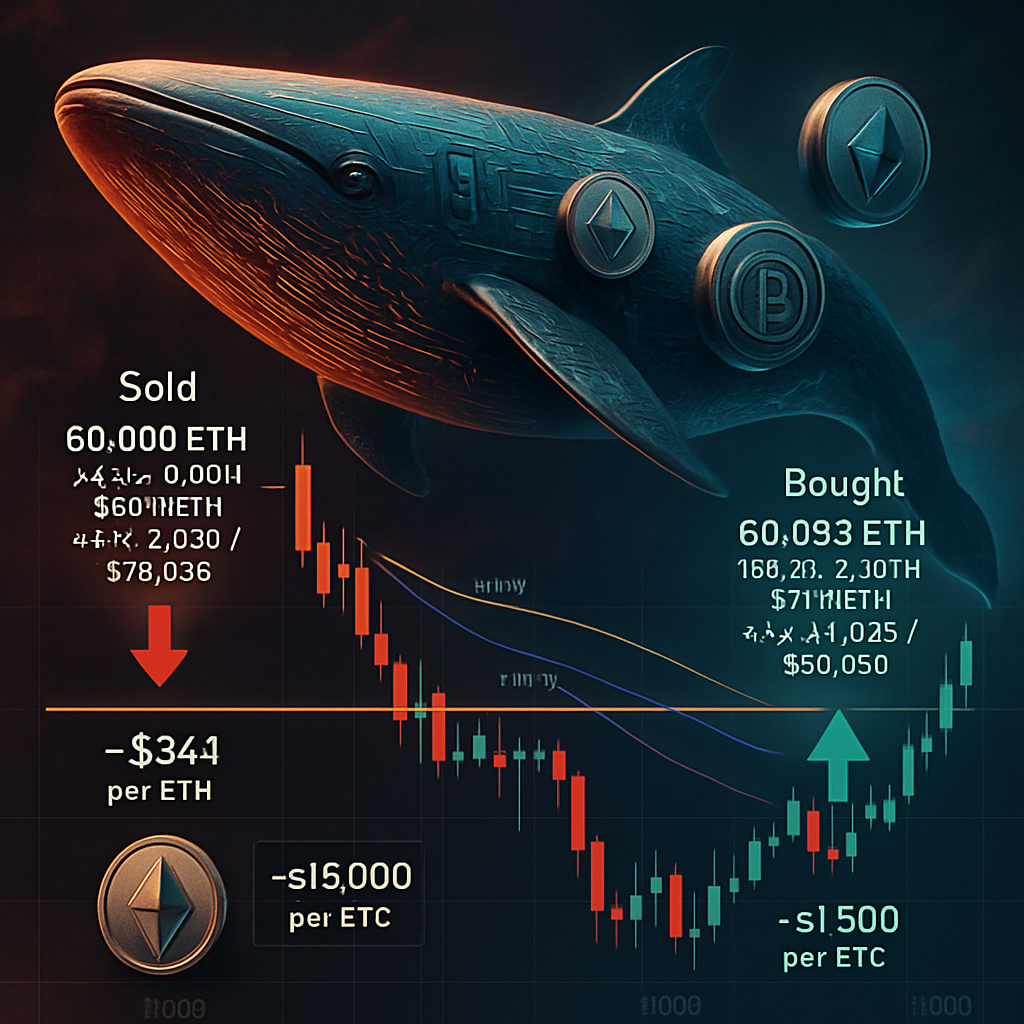
Ethereum rebounded above $1,650 after last week’s sharp sell-off, as on-chain data highlighted a large, early Ethereum holder who cut exposure before the drop and rebuilt positions near the lows. The transactions, surfaced by Arkham Intelligence, underscore how at least one veteran wallet anticipated the move and executed a round-trip across ETH, wrapped staked ETH (wstETH), and Wrapped Bitcoin (WBTC).

Whale Reduced Risk Ahead of the Sell-Off

According to Arkham Intelligence, a long-standing Ethereum wallet trimmed risk across three assets shortly before the market broke lower. The address exited positions at average prices that preceded the downturn:

  • Sold 60,000 ETH at an average price of about $2,040
  • Sold 9,442 wstETH at an average price of about $2,040
  • Sold 600 WBTC at an average price of about $78,538

In aggregate, the exits totaled roughly $188 million across ETH, wstETH (the non-rebasing wrapped version of Lido’s stETH), and WBTC, per Arkham’s on-chain data.

Rebuilt Positions Near the Lows

After stepping aside, the same wallet re-entered the market as prices reset lower:

  • Bought 60,088 ETH and 10,000 wstETH at an average price of about $1,606
  • Bought 611 WBTC at an average price of about $63,280

The price delta between the wallet’s exit and re-entry was substantial. For Ethereum, the spread was approximately $434 per ETH between the average sell and buy levels, applied across roughly 70,000 ETH and wstETH combined. For Bitcoin, the gap between the average sell ($78,538) and buy ($63,280) prices was about $15,000 per BTC. Executed across three assets, the sequence points to a deliberate strategy rather than a reactive trade, based on the timing shown in Arkham’s dataset.

ETH Technical Picture: $1,800 Now Key Resistance

Despite the bounce, Ethereum’s broader trend remains fragile. ETH lost the critical $1,800 support area during the sell-off and slid into the $1,500–$1,600 range. Price is trading below the 50-day, 100-day, and 200-day moving averages, all of which slope downward—an alignment that keeps momentum skewed toward sellers.

The breakdown below the $1,800–$1,900 zone—an area that served as a demand region through late winter and spring—signals that bulls ceded a major level. While ETH has recovered from lows near $1,520, reclaiming and holding above $1,800 is the first test for shifting sentiment. Until then, rallies are likely to be treated as relief moves rather than a confirmed trend reversal.

What to Watch

  • Whether ETH can retake $1,800 and the 50-/100-/200-day moving averages to neutralize downside momentum.
  • Further activity from large wallets following the recent round-trip, as indicated by on-chain trackers like Arkham.
  • Correlation with Bitcoin, which remains a key driver of broader crypto risk appetite.

Old SEC Order Blocks Bilzerian’s Crypto Plans

Wellermen Image SEC Wins Fresh Clampdown on Bilzerian’s Crypto Ventures

A federal judge just locked down an old 2001 injunction, ruling that Paul Bilzerian and his family cannot launch or finance new ventures—including anything touching digital assets—without first clearing it with the SEC. The move matters because it shows how legacy enforcement orders can stretch into crypto markets, giving regulators a ready-made tool to police unregistered offerings and token launches tied to previously sanctioned actors.

The case traces back to a 1989 SEC lawsuit that accused Bilzerian of massive securities fraud in the 1980s takeover boom. After years of evasion and asset-hiding, the court in 2001 barred him and his inner circle from starting any new securities-related business without prior approval. Fast-forward two decades and Bilzerian’s son, Alexander, sought to raise money for a crypto-related venture. The SEC cried foul, arguing the plan violated the standing injunction. Bilzerian’s side countered that the order was outdated, overly broad, and never meant to reach blockchain projects. Judge Royce Lamberth rejected those arguments, holding that the 2001 language is clear, still in force, and covers any new “leg” of securities activity—including tokens that function like investment contracts.

The ruling hands the SEC an immediate victory: Bilzerian’s proposed crypto venture is blocked unless the agency signs off, and future attempts to skirt the order will face swift contempt proceedings. Bilzerian and his associates lose the chance to operate in gray areas; the Commission gains practical precedent that decades-old judgments can police modern token sales. Markets absorb a quiet signal—old enforcement decrees carry forward, and regulators will use them against repeat players eyeing digital-asset fundraising.

In plain terms, the court is saying that once the SEC obtains a lifetime prior-approval order, it stays live even as technology changes. Crypto projects floated by anyone covered by such decrees now carry an extra regulatory gate: file with the agency or risk injunction enforcement and potential asset freezes. The decision does not expand the SEC’s statutory reach, but it lengthens the shadow of past fraud judgments over new blockchain ventures.

For traders and issuers, the opinion tightens the risk premium around tokens linked to previously sanctioned promoters. Exchanges listing such assets may face delisting pressure or enhanced due-diligence demands, while DeFi protocols accepting liquidity from these actors could inherit secondary liability concerns. The SEC’s authority is unchanged on paper, yet its practical leverage grows because one old paper order can now chill an entire class of digital offerings.

The market takeaway is blunt: legacy judgments are live ammunition—ignore them and your token launch just became a contempt hearing.

SCOTUS Narrows SEC’s Grip on Crypto Securities, Boosting Real-Utility Tokens

Wellermen Image SEC LOSES GROUND IN CRYPTO CLASSIFICATION FIGHT

The Supreme Court just narrowed the SEC’s ability to label tokens as securities in a ruling that could redraw enforcement lines for the entire industry. The decision limits how broadly the agency can stretch the Howey test, signaling that not every digital asset sale automatically triggers federal securities rules. Markets are already pricing in lighter compliance costs and fresh capital inflows for projects that once sat in legal limbo.

The case began when the SEC sued a mid-tier token issuer for selling what it called unregistered securities through a decentralized launch platform. Lower courts split on whether the token’s utility features and secondary-market trading removed it from securities classification. The issuer appealed, arguing the agency’s theory would swallow nearly every crypto project under an outdated 1940s framework. The justices accepted the case to settle how “investment contract” applies when buyers expect profits from code, liquidity pools, and community governance rather than a single promoter’s efforts.

In a 6-3 decision written by Justice Kagan, the Court held that tokens sold with genuine consumptive utility and traded on permissionless protocols do not automatically meet the Howey test’s “efforts of others” prong. The majority stressed that profit expectations must be tied primarily to the issuer’s ongoing managerial work, not merely to broader market adoption or protocol upgrades. Dissenters warned the ruling hands platforms a roadmap to evade oversight by adding thin utility features. The SEC lost its broad enforcement theory; token issuers and decentralized exchanges gained breathing room.

The ruling narrows the agency’s reach without erasing it. Projects must still avoid marketing tokens primarily as profit vehicles and must keep utility features real rather than cosmetic. Secondary-market trading alone no longer triggers automatic securities liability, but direct issuer sales tied to explicit return promises remain exposed. The decision does not touch commodities jurisdiction, leaving CFTC oversight intact for spot trading and futures.

Exchanges gain immediate leverage to relist previously delisted tokens without fearing SEC enforcement, while DeFi protocols can design governance tokens with clearer utility shields. Stablecoin issuers receive indirect relief, as the opinion suggests that yield-bearing reserves marketed for returns could still face scrutiny. Traders face lower legal overhang, encouraging risk-taking in mid- and small-cap tokens that had been frozen by regulatory uncertainty. The biggest shift is psychological: markets now see the SEC’s once-expansive authority as judicially constrained rather than limitless.

This decision hands crypto projects a temporary runway, but only those that can prove real utility will stay out of the agency’s crosshairs.

×