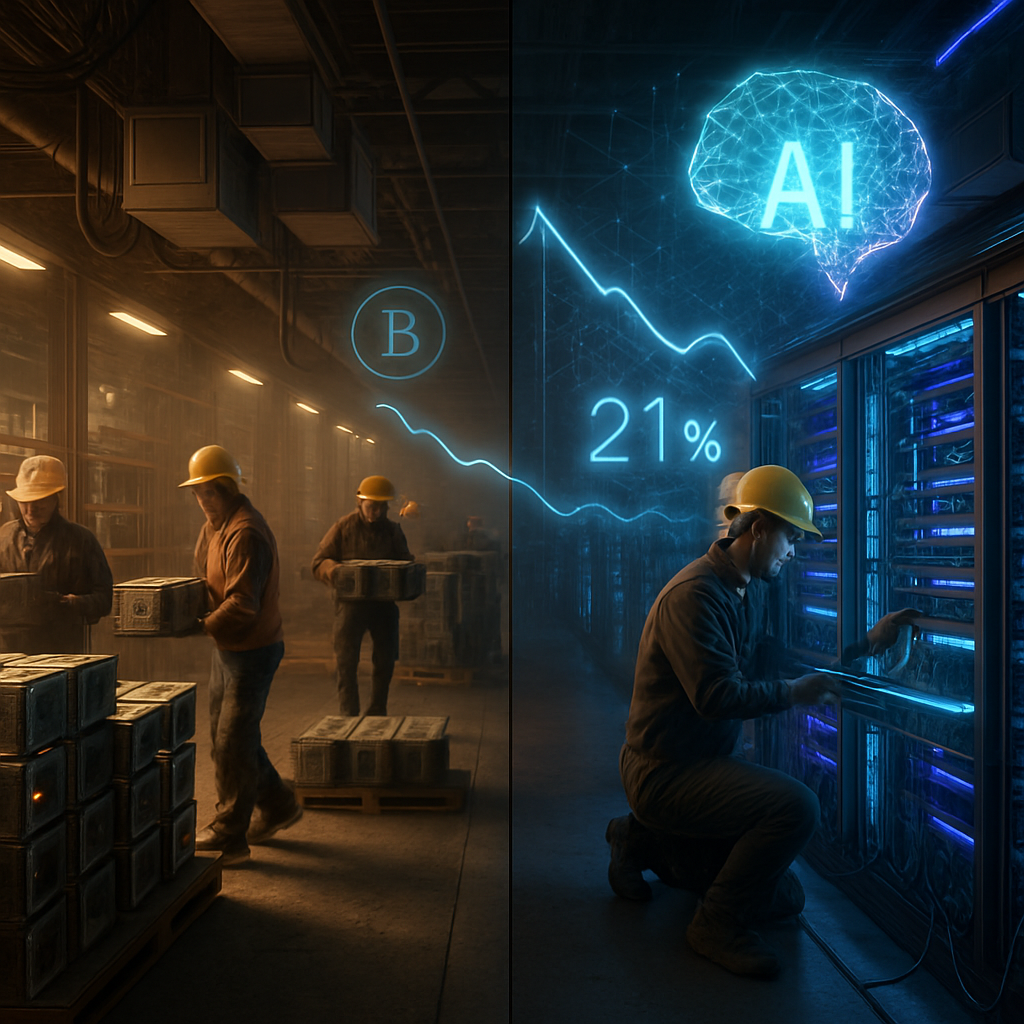
Publicly listed bitcoin miners have reduced their collective share of the Bitcoin network’s computing power by 21% in recent months as demand for artificial intelligence and high‑performance computing (HPC) accelerates. Operators are reallocating power capacity, data center space, and capital toward GPU-driven workloads that are generating faster and more predictable revenue than bitcoin mining.
Miners Pivot Toward AI and HPC
Over the past quarter, multiple North American mining firms have dismantled or repurposed parts of their bitcoin mining fleets to support AI and HPC infrastructure. While application-specific integrated circuits (ASICs) used for bitcoin cannot perform AI tasks, miners are converting facilities—power delivery, racking, cooling, and networking—to host GPU clusters for AI training and inference.
The shift is driven by robust demand for compute from AI developers and enterprises, which has created strong pricing and the potential for multi‑year hosting contracts. For miners facing revenue volatility tied to bitcoin price cycles, long-term AI/HPC agreements can enhance cash-flow visibility and improve return on invested capital for existing energy and data center assets.
Impact on Network Dynamics and Miner Economics
The 21% drop reflects a decline in the share of hashrate attributable to publicly traded miners, not an equivalent reduction in the Bitcoin network’s total hashrate. As public operators pivot capacity, privately held miners and international participants may absorb a larger portion of network computing power.
Bitcoin miner economics have tightened following the most recent block subsidy halving, which reduced issuance rewards by 50%. Combined with elevated energy costs in some regions and a competitive hardware cycle, the halving has pushed operators to optimize margins. Diversifying into AI/HPC can lift revenue per megawatt compared with bitcoin mining, depending on contract terms, utilization, and power markets.
What Is Being Repurposed
Miners are not converting ASIC machines into AI hardware. Instead, they are:
- Redeploying power infrastructure and data center space to host GPU servers.
- Upgrading cooling, networking, and security to meet AI/HPC requirements.
- Pursuing long-term hosting or compute‑as‑a‑service contracts with AI clients.
This reconfiguration typically requires new capital for GPUs and supporting infrastructure, as well as lead times for procurement, permitting, and interconnection upgrades.
Outlook
Key variables to watch include miners’ monthly production updates, changes in public miners’ share of network hashrate, AI/HPC contract backlogs, GPU supply availability, and regional power prices. The pace of AI demand growth, together with regulatory and grid constraints, will influence how quickly bitcoin miners can expand HPC services and how the composition of the Bitcoin network evolves.