
Offshore Crypto Derivatives Fall Under U.S. Regs as Court Expands CFTC’s Reach

Wellermen Image Court Hands CFTC Fresh Power Over Crypto Trading Platforms

The D.C. Circuit just told the CFTC it can police off-exchange crypto derivatives even when no U.S. customer touches them, expanding Washington’s reach over digital-asset markets that until now enjoyed a quiet offshore lane. The ruling arrives as lawmakers debate stablecoin bills and the SEC circles spot-Bitcoin ETFs, sharpening the sense that every major crypto trade now carries a federal regulator’s shadow.

Trevor Kitchen, a trader who ran a peer-to-peer Bitcoin options desk outside U.S. borders, asked the Commission to drop its enforcement case after he moved servers to Malta and blocked American IP addresses. The CFTC refused, insisting that offering leveraged crypto contracts to any trader who might later route funds through a U.S. bank was enough to trigger U.S. jurisdiction. Kitchen appealed, arguing the agency was stretching the Commodity Exchange Act past its territorial limits and chilling legitimate foreign business.

Writing for a unanimous panel, Chief Judge Srinivasan held that the Act’s “direct and significant” effects test reaches foreign platforms whenever dollar-clearing or U.S. bank wires are foreseeable, even if the contract itself is booked abroad. The court rejected Kitchen’s “targeting” argument, saying that once a product is designed to settle in dollars, the platform effectively plugs itself into the U.S. financial grid and must obey CFTC rules on fair pricing, segregation of customer funds, and trade reporting.

In plain English, any crypto exchange or DeFi protocol that offers futures-style products, options, or leveraged tokens in dollars now risks CFTC registration and oversight if even a modest slice of volume clears through American banks or stablecoin issuers. That lowers the appeal of anonymous offshore entities and raises compliance costs for DEX aggregators that rely on USDT or USDC settlement, while handing registered futures commission merchants a competitive edge.

Exchanges that already hold CFTC licenses will likely see volume migrate from gray-market rivals, but pure-code DeFi options vaults could face a fork in the road: geoblock U.S. persons and lose liquidity, or restructure as registered entities and accept on-chain reporting obligations. Stablecoin issuers, meanwhile, inherit indirect scrutiny because their peg instruments are now the rails the court used to anchor foreign platforms to U.S. jurisdiction.

The message to traders and builders is blunt: dollar exposure equals U.S. oversight, and pretending otherwise just became an expensive legal bet.


Bitcoin Surges to $70K as $1.9B Liquidates, Shorts Steamrolled

Bitcoin surged on Wednesday, triggering more than $1.9 billion in crypto market liquidations over 24 hours, with short positions accounting for the vast majority. The rally pushed BTC to within sight of $70,000 before the price consolidated above $68,200.

Short Liquidations Dominate Derivatives Wipeout

Total liquidations across the crypto market exceeded $1.9 billion in the 24-hour span, including approximately $1.74 billion in short positions. The imbalance indicates a broad short squeeze, where traders betting against rising prices were forced to close positions as the market moved higher.

Liquidations occur when leveraged positions are automatically closed by exchanges after margin requirements are breached, often amplifying price moves during periods of heightened volatility.

Macro Catalyst: Treasury Buyback Reports

The spike followed reports that the U.S. Treasury plans to double its bond buybacks to $4 billion, a move seen as supportive for market liquidity. Risk assets, including cryptocurrencies, often react to shifts in liquidity expectations and broader macro signals.

Price Action and Key Levels

BTC briefly rallied toward the psychological $70,000 level before easing and consolidating above $68,200. The swift move and subsequent stabilization underscore elevated volatility around key resistance levels as traders reassess positioning in light of macro developments and derivatives market dynamics.

Ninth Circuit Upholds CFTC Win: Trader Faces Lifetime Ban and $1.6 Million Restitution

Wellermen Image CFTC WINS ON APPEAL, TRADER FACES LIFETIME BAR

The Ninth Circuit has upheld a CFTC victory against trader James Devlin Crombie, ruling that he must pay $1.6 million in restitution and civil penalties while facing a lifetime trading ban. The decision cements the agency’s power to punish fraudulent futures schemes and tightens the regulatory net around retail investors lured into crypto-adjacent derivatives markets.

The case began when Crombie ran a futures-trading program that promised investors outsized returns but instead diverted funds to personal use. The CFTC sued in 2011, alleging fraud and misappropriation. A California district court granted summary judgment in the agency’s favor; Crombie appealed, arguing that the CFTC lacked authority to impose lifetime trading bans and that the restitution figure was inflated.

The three-judge panel rejected every claim. It found that the Commodity Exchange Act explicitly grants the CFTC power to seek permanent injunctions and restitution when fraud is proven, and that Crombie’s evidence of investor consent was insufficient to create a genuine issue of fact. The court also held that the district court’s $1.6 million calculation, based on investor deposits minus any returned sums, was a reasonable approximation of loss.

In plain terms, the ruling lowers the bar for proving fraud and raises the ceiling for penalties—any scheme that mixes futures with digital-asset promises now carries heavier legal risk.

The decision reinforces the CFTC’s role as the lead cop for crypto-linked derivatives, even as the SEC spars with the same platforms over token classification. Exchanges and DeFi protocols that offer leveraged products must now weigh the threat of lifetime bans and multimillion-dollar judgments against the revenue from high-risk retail traders.

For traders and sponsors, the takeaway is blunt: the Ninth Circuit just made “trust me” pitches in futures markets far more expensive.

Court Blocks Blanket IRS Seizures of 24 Crypto Wallets Without Proof of Illicit Activity

Wellermen Image Court Slaps IRS on Asset Seizures in Crypto Account Case

A federal judge in Washington has just told the IRS it cannot simply freeze twenty-four cryptocurrency accounts without proving the owners are breaking the law. The ruling stops the government cold in its tracks and forces a reset in how tax agents hunt for unreported crypto gains.

The IRS launched the seizure after seeing large transfers and suspecting tax evasion, but the agency never showed any evidence that the accounts were actually used for illegal activity. The judge ruled the government must provide specific facts, not just patterns and hunches, before it can take control of private digital wallets. The decision hands the account holders a temporary victory and sends a clear warning to federal agents.

The ruling lands at a moment when the IRS is racing to close a widening tax gap in digital assets. By demanding real proof of wrongdoing, the court raises the bar for future seizures and forces investigators to build stronger cases before freezing wallets. Exchanges and DeFi protocols now have breathing room to argue that blanket account sweeps violate due process.

In plain terms, the government can still pursue unpaid taxes, but it must show probable cause tied to each account rather than relying on broad data sweeps. That shifts power back to users and platforms, making mass account freezes riskier and more expensive for regulators.

For crypto markets, the decision tilts the balance toward decentralization and user control. It reduces the threat of sudden liquidity shocks from government takings and lowers regulatory overhang for exchanges that must decide whether to freeze customer funds on request. Traders gain a measure of protection, while the IRS faces higher evidentiary costs that could slow enforcement campaigns.

The message is simple: the IRS cannot treat every large crypto transfer as a crime until it proves otherwise.

SEC Wins First Round Against Binance: Tokens Likely Securities, Exchanges Hit With Registration Push

Wellermen Image SEC WINS FIRST ROUND AGAINST BINANCE IN D.C.
The Securities and Exchange Commission just secured a sweeping early victory in its landmark case against Binance, the world’s largest crypto exchange. A federal judge in Washington allowed the SEC’s core claims to move forward, ruling that unregistered sales of BNB, BUSD, and staking services violated federal securities law. The decision signals that the agency can keep treating major tokens as securities and that exchanges operating without registration face real legal exposure.

The lawsuit erupted in June 2023 when the SEC accused Binance and its former CEO Changpeng Zhao of operating an unregistered exchange, commingling customer funds, and selling unregistered securities. Binance fought back hard, arguing that the tokens in question were not securities and that the SEC lacked authority over decentralized platforms. In a 91-page opinion, Judge Amy Berman Jackson rejected most of Binance’s motion to dismiss, finding the SEC had plausibly alleged that BNB and BUSD were investment contracts under the Howey test and that the company’s staking program offered investors profits derived from Binance’s efforts.

The court dismissed a few narrow claims, such as those tied to simple wallet transfers and certain isolated token sales, but the heart of the case survived. Binance must now answer allegations that it deliberately structured operations to evade U.S. rules while courting American customers. Zhao, who already pleaded guilty to criminal violations and stepped down, is no longer a defendant in the civil case, but the exchange itself faces potential injunctions, disgorgement, and monitoring.

In plain terms, the ruling tells exchanges that if tokens are marketed as investments and buyers expect profits from the promoter’s work, those tokens can be securities—even if they also function as utility coins. Binance’s argument that decentralization or secondary-market trading removes SEC oversight was largely rejected. This means more platforms could face enforcement unless they register or restructure, and the threat of enforcement actions is no longer theoretical.

For markets, the decision tilts power toward the SEC and away from industry arguments that most tokens fall outside securities law. It raises fresh compliance costs for exchanges and DeFi protocols that offer staking or yield, and it clouds the status of stablecoins like BUSD that blend payments utility with investment features. Traders should expect tighter liquidity on affected tokens, potential delistings, and a renewed push by platforms to either register or relocate. Decentralization remains a defense only if genuine; marketing and managerial efforts still trigger regulatory risk.

The message to crypto firms is simple: the SEC’s authority just got judicial reinforcement, and ignoring registration requirements is no longer a calculated gamble—it’s a liability.

Here are 5 punchy options under 12 words: – Standard Chartered and HSBC Execute First Live SWIFT Blockchain Transaction – First Live SWIFT Blockchain Transaction by Standard Chartered and HSBC – Standard Chartered, HSBC Process First Live SWIFT Blockchain Transaction – Standard Chartered and HSBC Complete First Live SWIFT Blockchain Transaction – First Live SWIFT Blockchain Transaction Achieved by Standard Chartered and HSBC

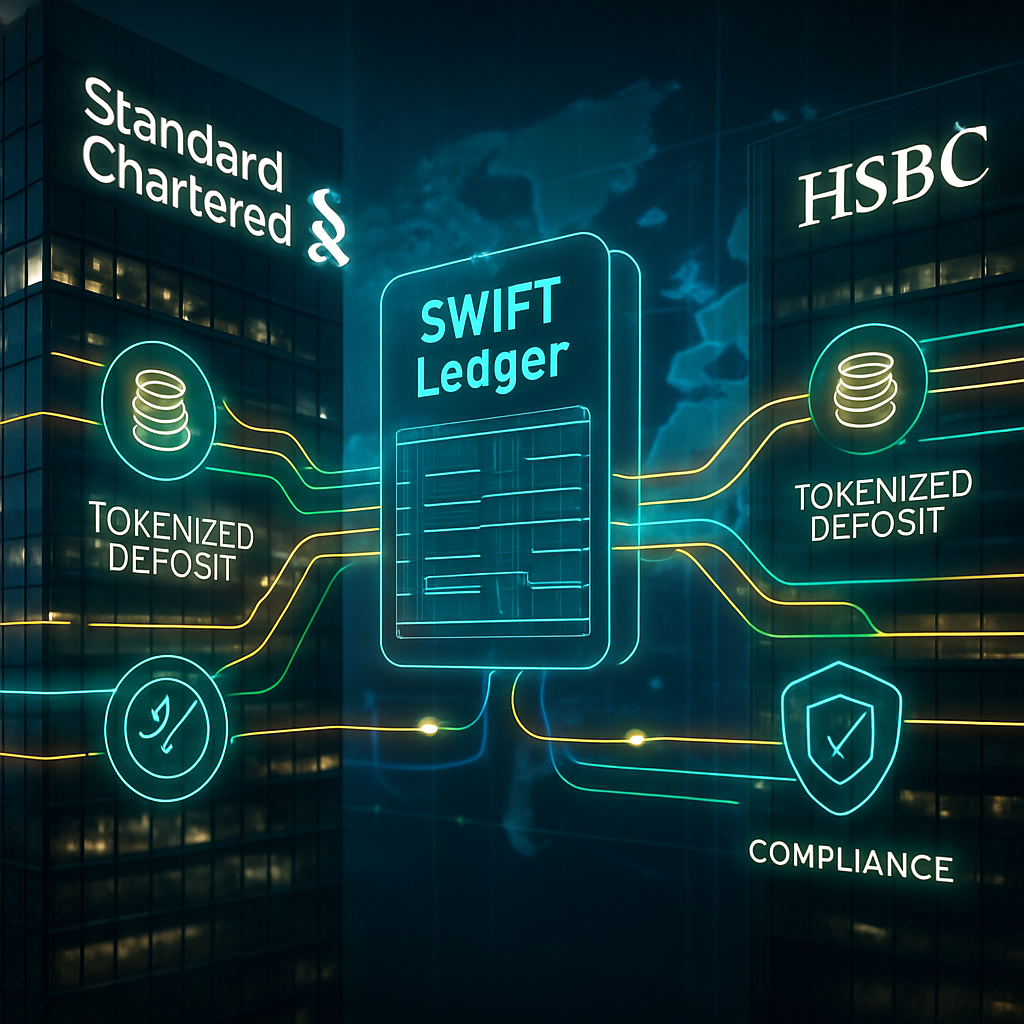
Standard Chartered and HSBC have executed the first live transaction linking their separate tokenized deposit platforms through Swift’s blockchain-based ledger, a step toward interoperable, always-on cross-border payments between major financial institutions.

Live connection between tokenized deposit systems

The banks conducted a live transfer by connecting their tokenized deposit systems via Swift’s ledger infrastructure. The milestone demonstrates how bank-issued digital liabilities can interoperate across institutions using a shared network, without relying on a single proprietary platform.

Tokenized deposits are digital representations of commercial bank money recorded on distributed ledger technology (DLT). Unlike public stablecoins, they remain within the regulated banking system and are redeemable 1:1 against deposits at the issuing bank.

Why it matters

Cross-border payments have historically been limited by fragmented systems, operating hours, and correspondent banking processes. Interoperable tokenized deposits could enable:

  • 24/7/365 settlement across jurisdictions
  • Reduced operational friction and reconciliation needs
  • Improved transparency and programmability for cash movements

For Swift, the live transaction supports its strategy to provide a neutral interoperability layer for digital assets and digital forms of money, allowing institutions to connect existing infrastructures to emerging DLT-based rails.

Broader industry context

Banks and market infrastructures globally are testing tokenized deposits, central bank digital currency (CBDC) models, and tokenized assets to modernize settlement. Interoperability across different DLT platforms and traditional systems is seen as essential to scale these innovations safely and within regulatory frameworks.

What’s next

Further trials are expected to focus on throughput, resiliency, compliance workflows, and multi-currency corridors. Successive pilots could pave the way for production-grade, cross-border tokenized money movements that coexist with current payment rails while extending service hours and functionality.

Delaware Court Clears Discovery in Crypto IP Case, Empowering Founders

Wellermen Image Delaware Court Hands Crypto Founders A Legal Win

Delaware’s Superior Court just green-lit a fraud and breach-of-contract lawsuit brought by Diamond Fortress Technologies and its founder Charles Hatcher II, ruling that the defendants must face claims they allegedly misappropriated a blockchain-based identity verification system. The decision matters because it signals that Delaware judges are willing to let crypto-related contract disputes proceed to discovery rather than tossing them on procedural technicalities, giving founders a clearer path to litigate stolen intellectual property in the state most companies call home.

The fight started when Diamond Fortress and Hatcher alleged that former partners walked away with the source code and customer pipeline for a decentralized identity platform, then tried to shop it to investors under a new venture. Defendants moved to dismiss, arguing the claims were too vague and that any damages were speculative. The court rejected both arguments, holding that the complaint pleaded specific misrepresentations, concrete lost licensing fees, and a plausible timeline linking the alleged theft to the defendants’ competing product launch. In plain terms, the judges found enough smoke to let the case move toward finding the fire.

Under Delaware law, that means the plaintiffs can now subpoena emails, Slack logs, and investor pitch decks—tools that often decide whether a crypto dispute settles quietly or explodes into public filings. The ruling doesn’t decide who’s right on the facts, but it keeps the pressure on the defendants to choose between costly discovery or a settlement that could include cash, code escrow, or even token warrants.

For the wider market, the decision is a reminder that contract and IP claims in crypto will mostly be settled in Delaware’s Court of Chancery or Superior Court, not federal crypto-specific forums. That keeps legal risk localized and somewhat predictable for exchanges and DeFi teams that incorporate or raise money in the state, but it also means founders must still draft tight licensing and joint-development agreements—judges will enforce them once the paperwork is clear. Stablecoin issuers and token projects that rely on proprietary oracle or identity stacks should take note: the cost of sloppy vendor contracts just ticked higher.

Founders who skimp on airtight IP assignments may soon learn that Delaware courts will let plaintiffs open the books.

Grayscale Wins Court Challenge, Forcing SEC to Reconsider Bitcoin ETF Decision

Wellermen Image Grayscale Wins, SEC Authority Takes a Hit

Grayscale Investments just forced the SEC’s hand. The D.C. Circuit ruled the agency acted arbitrarily when it rejected the firm’s spot Bitcoin ETF while allowing nearly identical futures-based products. The decision doesn’t green-light the ETF tomorrow, but it yanks the rug from under the SEC’s “we don’t have to explain ourselves” defense and hands crypto markets fresh ammunition in the fight for regulatory clarity.

The case began in 2021 when Grayscale asked the SEC to convert its Bitcoin Trust into an exchange-traded fund. The Commission said no, citing worries about fraud and manipulation in spot Bitcoin markets. Grayscale sued, pointing out that the agency had already approved futures-based Bitcoin ETFs that track the same asset. The legal question was simple: can the SEC treat economically identical products differently without a coherent explanation? The three-judge panel said no.

Judges sent the denial back to the SEC for a do-over, ruling that the Commission failed to show why futures ETFs are safer than a spot product. The court didn’t force approval, but it rejected the agency’s logic as inconsistent and inadequately reasoned. Grayscale gets another shot at the application; the SEC must now either approve, reject with better reasoning, or risk losing again in court. For now, the win belongs to the industry, the loss to the Commission’s credibility on crypto oversight.

The ruling narrows the SEC’s room to maneuver on novel crypto products. By demanding consistent treatment of similar assets, the court signals that regulators can’t pick winners and losers without hard evidence. This doesn’t strip the agency of authority, but it raises the bar for future rejections and invites more lawsuits if explanations look flimsy.

For markets, the decision tilts the playing field toward spot Bitcoin ETFs and weakens the SEC’s chokehold on product approvals. It pressures the agency to articulate clearer standards on market manipulation and custody, issues that also loom over Ethereum and other tokens. Exchanges and issuers will read this as an opening to push more spot products; traders will price in a higher probability of eventual approval, lifting GBTC’s discount and related derivatives. The CFTC’s lighter touch on futures gains indirect validation, sharpening the long-running SEC-CFTC turf war.

The SEC can still say no, but after today it has to mean it.

Court Rules Tokenized Crypto Perpetuals Are Futures, Forcing CFTC Registration

Wellermen Image CFTC Wins—Crypto Promoter Now a Futures Trader


A federal appeals court just told a crypto promoter that selling tokenized futures contracts without CFTC registration is illegal. The ruling expands the agency’s reach over any digital asset that behaves like a futures contract, even if it sits on a blockchain and claims to be “decentralized.”

James Donelson sold investors what he called “perpetual crypto contracts,” promising leveraged exposure to Bitcoin and Ethereum prices. The CFTC sued, arguing the contracts were unregistered futures. Donelson fought back, claiming his products were not futures because they never expired and lived on a blockchain. The Seventh Circuit disagreed, holding that the economic reality of the product—not its label or technology—decides whether it falls under the Commodity Exchange Act.

The court found that Donelson’s contracts gave buyers the right to profit or lose from price moves without ever owning the underlying coins, exactly how futures work. Because he marketed them to the public and held customer funds, he needed to register as a futures commission merchant. He didn’t, so the CFTC wins. Donelson loses his business model and faces possible restitution orders; crypto traders who bought his products may now pursue claims under CFTC reparations rules.

In plain English, the decision says that calling something “crypto” or “DeFi” does not remove it from futures regulation if it replicates futures economics. The CFTC’s authority just expanded to cover any platform offering leveraged, margined, or financed crypto exposure that settles in cash rather than delivery.

For markets, the ruling tightens the noose around offshore and on-chain perpetuals desks that have so far operated in gray zones. Exchanges listing similar products will need CFTC registration or structural changes to avoid the same fate. Traders face a shrinking menu of unregistered leverage products and higher compliance costs baked into the platforms that remain. Stablecoin issuers offering yield or leveraged products tied to their tokens should also reassess whether they are now futures intermediaries.

The message is simple: if it walks like a futures contract, the CFTC can regulate it—even on the blockchain.

Bitcoin and Ethereum News: HSBC, Standard Chartered Live Swift 24/7 Ledger

SWIFT has executed its first cross-border transaction under a pilot program testing settlement, as the global interbank network adapts to the growing use of stablecoins and tokenized deposits in international payments.

Pilot marks first cross-border settlement test

The pilot represents SWIFT’s initial cross-border transaction in a program focused on settlement capabilities. The effort is part of the organization’s push to maintain relevance as digital assets and tokenized forms of money gain traction across global finance.

SWIFT, a financial messaging network used by banks and market infrastructures worldwide, traditionally facilitates the secure exchange of payment instructions rather than moving money itself. Testing settlement processes signals an exploration of how its network could interoperate with emerging forms of digital value and new payment rails.

Why it matters

Cross-border payments remain slow and complex compared to domestic transactions. Stablecoins and tokenized deposits promise faster, programmable, and potentially round-the-clock settlement, increasing competitive pressure on legacy systems. By piloting settlement, SWIFT is positioning to coordinate flows across institutions and technologies while preserving the compliance, interoperability, and standards its members rely on.

Stablecoins and tokenized deposits explained

Stablecoins are digital tokens designed to maintain a stable value, typically by being pegged to a fiat currency such as the U.S. dollar. They are increasingly used for remittances, trading, and treasury movements due to their speed and global reach.

Tokenized deposits are bank deposit liabilities represented as tokens, often on distributed ledger technology. Unlike stablecoins issued by non-bank entities, tokenized deposits remain within the regulated banking framework, potentially enabling on-chain settlement while maintaining existing compliance and risk controls.

Outlook

The pilot underscores the rapid convergence of traditional payment infrastructure and digital asset technologies. As adoption of stablecoins and tokenized deposits expands, financial institutions are testing models that deliver faster settlement without sacrificing standards, interoperability, or regulatory safeguards. Further details on the pilot’s scope, participants, and timelines were not disclosed.

Coinbase Wins Court Battle, SEC Must Explain Crypto Rulemaking Silence

Wellermen Image Coinbase Beats SEC in Court — But the War Isn’t Over


The Third Circuit Court of Appeals has just ruled that Coinbase can challenge the SEC’s refusal to provide clearer rules for crypto assets, dealing a rare procedural win to the exchange and forcing the regulator to defend its hands-off approach in public. The decision does not decide whether specific tokens are securities, but it opens the courthouse door for Coinbase to argue that the SEC’s refusal to engage in rulemaking is arbitrary and harmful to the entire industry.

The fight began when Coinbase filed a formal petition asking the Commission to write new rules that would tell companies exactly which digital assets count as securities and how exchanges should handle them. The SEC denied the petition without much explanation, essentially saying the existing legal framework already works. Coinbase appealed, arguing that the agency’s silence and inconsistent enforcement created impossible compliance conditions and chilled innovation. A three-judge panel in Philadelphia agreed that courts can review such denials, rejecting the SEC’s claim that its discretion was unreviewable.

Judges Ambro, Bibas, and Phipps held that the Administrative Procedure Act allows judicial oversight when an agency refuses to make rules, especially on emerging technologies where guidance is scarce. The ruling sends the case back to a lower court for a full hearing on whether the SEC’s refusal was reasonable. Coinbase gains breathing room and political momentum; the SEC loses the ability to hide behind blanket claims of unreviewable discretion.

In plain terms, the court told the SEC it cannot simply say “trust us” when the industry asks for guardrails. The decision does not force new rules tomorrow, but it makes it harder for the regulator to keep dodging the question of how existing securities law applies to staking, DeFi, and token issuances.

For markets, the ruling tilts authority slightly away from unchecked SEC power and toward judicial review, injecting new uncertainty into enforcement actions that rely on the agency’s say-so alone. Traders will read the decision as evidence that the SEC’s aggressive posture is no longer bulletproof, which could lift sentiment for exchange tokens and DeFi governance coins. Stablecoin issuers and large platforms may treat the win as cover to keep pushing products while the legal fight drags on, betting that courts will keep demanding clearer lines.

The case now moves from whether Coinbase can sue to whether the SEC must finally draw those lines—and every delay or new lawsuit widens the gap between rapid product launches and slow regulatory clarity.

Here are punchy options under 12 words: – Bitcoin Capitulation: 8 of 12 Signals, Bottom Not In, VanEck Says – Bitcoin Capitulation Signals: 8 of 12; Bottom Not In, VanEck Says – Bitcoin: 8 of 12 Capitulation Signals; Bottom Not In, VanEck

Bitcoin’s current market structure resembles previous periods that were followed by weaker medium-term performance, according to an asset manager, which noted that similar setups have historically produced below-average 90-day and 180-day returns.

Historical Signal Points to Softer Medium-Term Performance

The asset manager said recent conditions mirror past instances that preceded muted outcomes over the next three and six months. While the note did not specify the precise indicators behind the assessment, such “setups” in crypto markets typically refer to combinations of price momentum, positioning, and liquidity dynamics that have shown repeatable patterns over time.

Why 90-Day and 180-Day Windows Matter

Ninety- and 180-day horizons are common benchmarks for evaluating medium-term performance in digital assets, capturing more than short-term volatility while remaining sensitive to cyclical trends. Historical underperformance over these windows can reflect shifts in investor risk appetite, funding conditions in derivatives markets, or periods of consolidation following strong directional moves.

Key Factors to Monitor

  • Liquidity and market depth across major exchanges
  • Derivatives positioning, including funding rates and open interest
  • Macroeconomic signals such as interest-rate expectations and dollar strength
  • Spot market flows, including large-scale purchases or distributions

Outlook

While historical patterns can inform expectations, they do not guarantee future results. The asset manager’s observation suggests a cautious stance on medium-term return prospects for bitcoin (BTC), with upcoming macro data, risk sentiment, and market structure likely to determine whether this pattern persists or breaks.

Bitcoin’s Investment Case Holds, BlackRock Says After 50% Drop

BlackRock says bitcoin’s decline of more than 50% from its October 2025 peak has not altered the asset’s long-term investment case. In a new report, the asset manager maintains its suggested 1–2% portfolio allocation to bitcoin, funded by trimming equities.

BlackRock Reaffirms Bitcoin Thesis

In a report titled “Re-Underwriting Bitcoin,” BlackRock outlines why it believes the cryptocurrency’s sharp drawdown does not change its strategic outlook. The firm reiterates that a modest, diversified exposure remains appropriate and recommends sourcing the allocation from equities rather than increasing overall portfolio risk.

Suggested Allocation: 1–2% Funded From Equities

  • Target allocation: 1–2% of a multi-asset portfolio.
  • Funding source: reallocate from equities, not cash or fixed income.
  • Rationale: maintain diversification while managing overall risk levels.

Market Context

Bitcoin (BTC) has experienced significant volatility since reaching an all-time high in October 2025, with prices subsequently falling more than half from that level. Despite the drawdown, institutional interest and infrastructure development around digital assets have continued to advance, even as regulatory and macroeconomic conditions remain key variables for the market.

Key Takeaways

  • BlackRock’s long-term view on bitcoin remains intact despite recent market weakness.
  • The firm continues to advocate a small, strategic allocation within diversified portfolios.
  • Funding the position from equities is intended to keep total portfolio risk in balance.

Arthur Hayes Becomes Flop Labs CEO Ahead of Q4 Airdrop

Arthur Hayes, co-founder and former CEO of BitMEX, has taken the helm at Flop Labs, an AI inference protocol, and signaled plans for a “massive airdrop” targeted for the fourth quarter of 2026.

Hayes Named CEO of Flop Labs

Hayes revealed he has assumed the role of CEO at Flop Labs, positioning the project within the growing intersection of artificial intelligence and blockchain infrastructure. The move brings a prominent crypto industry figure to a protocol focused on AI inference—computational processes that run trained AI models to produce outputs—where decentralized architectures are increasingly being explored for cost efficiency and resilience.

Airdrop Planned for Q4 2026

Alongside the leadership change, Hayes teased a “massive airdrop” slated for late 2026. Airdrops are commonly used by crypto projects to distribute tokens, bootstrap communities, and decentralize governance. While timing guidance was provided, specific terms for the distribution were not disclosed.

Background on Arthur Hayes

Hayes is best known for co-founding BitMEX, one of the earliest and most influential crypto derivatives exchanges. His return to a chief executive role at a new protocol is likely to draw attention from both digital asset traders and the broader web3 developer community.

What’s Still Unknown

  • Token details: ticker, total supply, and utility within the Flop Labs ecosystem.
  • Eligibility criteria: participation requirements, geographic restrictions, and any snapshot dates.
  • Distribution mechanics: allocation percentages for users, contributors, investors, and the team.
  • Regulatory considerations: compliance processes for users in different jurisdictions.

Flop Labs has not yet published formal documentation or a roadmap detailing the airdrop or protocol tokenomics. Further updates are expected as the project approaches its Q4 2026 timeline.

Maya Protocol Exploit Drains Bitcoin, Ethereum; Pool Value Plummets $11M

A cross-chain trading network suffered a critical incident in which a sequence of six flaws led to a liquidity pool being credited with nearly 50 million tokens that were never properly funded. The phantom balance allowed an attacker to withdraw assets with real market value, draining liquidity from the protocol.

Incident Overview

The event centered on incorrect crediting of a pool balance within the network’s cross-chain infrastructure. Because the system treated the unfunded credits as legitimate deposits, the attacker was able to execute withdrawals and swaps against the inflated balance, extracting real assets from the protocol.

How the Exploit Worked

According to initial details, a chain of six compounding flaws enabled the mis-accounting. The errors resulted in a pool being credited with nearly 50 million tokens without corresponding backing. With the protocol recognizing those tokens as spendable, the attacker used the artificial balance to pull liquidity from other assets held by the network.

Impact and Ongoing Risks

The exploit converted unfunded credits into outflows of genuine value, reducing available liquidity and potentially affecting users who interacted with the impacted pools. While the exact scope of the losses and the full technical breakdown were not disclosed in the available details, the mechanism highlights how layered validation and accounting failures can cascade into significant real-world losses.

Why It Matters

Cross-chain trading systems are complex and rely on precise accounting and validation across multiple networks. This incident underscores the risks of compounding logic and verification errors in decentralized finance, where a single point of failure can become systemic when combined with other oversights. Robust funding checks, strict invariants, rate limits, and rapid incident response are critical to minimizing exposure when anomalies occur.

×