
SCOTUS Slams SEC: Crypto Tokens Must Clear Howey Test in Court

Wellermen Image COURT DELIVERS DEVASTATING BLOW TO SEC ENFORCEMENT STRATEGY

The Supreme Court just handed the crypto industry its biggest legal victory in years, ruling that the SEC cannot unilaterally label digital assets as securities without proving investors expected profits from the efforts of others. The decision guts the agency’s enforcement playbook and forces regulators to prove their case in court rather than through administrative fiat.

The case originated when the SEC sued a major crypto exchange for allegedly selling unregistered securities, claiming that the platform’s tokens met the Howey test because buyers expected profits from the company’s development efforts. Lower courts split on whether the SEC’s classification power was absolute or subject to judicial review. The Supreme Court granted certiorari to resolve whether the agency could bypass traditional securities analysis by simply declaring tokens were investment contracts.

In a 6-3 decision written by Justice Kagan, the Court ruled that the SEC must demonstrate all four Howey prongs with concrete evidence rather than relying on its own administrative interpretations. The majority held that “mere promotional language” and “aspirational development roadmaps” do not automatically transform utility tokens into securities. Dissenting justices argued this creates an enforcement gap that bad actors will exploit, but the majority countered that Congress—not agencies—must expand securities definitions.

The ruling fundamentally shifts power from the SEC to courts and market participants. The agency can no longer threaten enforcement actions based solely on its interpretation of token economics. Instead, prosecutors must now prove in open court that token purchasers reasonably expected profits derived primarily from the promoter’s efforts—a much higher evidentiary bar that will slow enforcement dramatically.

This decision immediately weakens the SEC’s leverage in ongoing exchange cases and pending token enforcement actions. The CFTC gains relative authority as commodities classification becomes the default for tokens that fail the stricter Howey test. Exchanges gain breathing room to relist previously delisted assets, while DeFi protocols operating without clear securities exposure can resume development without constant regulatory overhang. Traders will likely see increased liquidity in mid-tier tokens as platforms test the new boundaries.

The SEC’s enforcement era just hit a brick wall—now watch for Congress to rewrite the rules before markets fully price in the regulatory vacuum.

Seventh Circuit Greenlights CFTC Crackdown on Crypto Derivatives

Wellermen Image CFTC Gets Green Light to Police Crypto Derivatives


The Seventh Circuit just told the CFTC it can keep going after unregistered crypto derivatives dealers, ruling the agency’s enforcement powers reach virtual-currency swaps and futures. The decision locks in broad oversight over any platform that lets traders bet on Bitcoin or Ether price moves, and it signals that “decentralized” is not a free pass from federal watchdogs.

The Conway Family Trust sued after the CFTC fined the trust’s unregistered crypto-options desk for offering leveraged Bitcoin contracts. The trust argued that Congress never gave the CFTC power over digital assets, that the products were securities outside the agency’s lane, and that enforcement violated due-process rights. A three-judge panel rejected each claim in a crisp 22-page opinion, holding that the Commodity Exchange Act’s definition of “commodity” is intentionally open-ended and that Bitcoin and Ether plainly fall inside it.

Judges Ripple, Kanne, and Scudder agreed that once a token trades on a derivatives market, its underlying value becomes a commodity subject to CFTC rules. They brushed aside the trust’s claim that decentralization shields platforms, noting that the statute targets “facilities” that bring together buyers and sellers—language that covers both traditional exchanges and crypto order books. The court also said the CFTC’s 2015 Bitcoin guidance gave fair notice, so the due-process argument failed.

In plain English, any U.S.-facing venue that lists futures, swaps, or options on crypto now faces the same registration, capital, and reporting duties as a CME clearinghouse. Spot-token trading and non-derivative DeFi protocols remain in a gray zone, but the moment leverage or margin enters the picture, the CFTC can treat the product like any other commodity contract.

The ruling hands the agency a litigation win it can wave at offshore exchanges and DeFi apps courting U.S. users. It also nudges stablecoin issuers to watch their backs: if their tokens are used as margin collateral, they could be swept into the CFTC’s net. Traders should expect tighter spreads on regulated venues and sharper enforcement against anonymous perpetual-swap platforms.

Bottom line: decentralization rhetoric just got a federal appellate reality check—leveraged crypto trading is now officially a regulated derivatives business.

Bitcoin News: 7 Catalysts Reviving Bitcoin, Says Strategy CEO

Strategy Inc. CEO Phong Le expects regulatory action, broader bank participation, and new digital financial products to revive activity in subdued bitcoin markets heading into the fall, with political and economic developments potentially adding further momentum.

Outlook for Fall Market Activity

Le said bitcoin trading has been subdued in recent months but could become more active as multiple catalysts converge. He pointed to regulatory progress, increased involvement from traditional financial institutions, and the rollout of digital financial products as likely drivers of renewed participation.

Regulatory and Institutional Drivers

  • Regulatory action: Policy updates and enforcement clarity could reduce uncertainty and encourage market engagement.
  • Expanding bank participation: Greater involvement from banks and other incumbents may deepen liquidity and broaden access to bitcoin-related services.
  • Digital financial products: New offerings built on digital asset infrastructure could attract both retail and institutional users.

Political and Macroeconomic Backdrop

Le noted that political and economic developments in the coming months may add momentum, as policy decisions, election-related signals, and macroeconomic trends often influence risk appetite and capital flows across crypto markets.

Why It Matters

A confluence of regulatory clarity, institutional participation, and timely product launches has historically impacted liquidity and volatility in bitcoin markets. If these factors materialize as Le anticipates, market activity could pick up into the fall.

Fifth Circuit Grants SEC Partial Victory in Token Fight, Keeps Core Security Question Open

Wellermen Image COURT HANDS SEC PARTIAL VICTORY IN FIFTH CIRCUIT TOKEN FIGHT

The Fifth Circuit just split the baby in a high-stakes crypto appeal, giving the SEC a procedural lifeline while leaving the core question of token classification wide open. The ruling keeps the case alive for further litigation, meaning the agency’s broad enforcement theory survives another round but faces a skeptical bench that could still gut its reach. Markets are watching because the decision signals the courts are not ready to hand the SEC a blank check on digital assets.

The dispute began when the SEC sued a token issuer for selling unregistered securities, arguing that the token’s marketing and profit-sharing features made it an investment contract under the Howey test. The issuer fought back, claiming the tokens were simple commodities and that the agency lacked authority to regulate them at all. A lower court dismissed the case on jurisdictional grounds, prompting the SEC to appeal and ask the Fifth Circuit to restore its enforcement power. The appeals panel agreed that the lower court jumped the gun, sending the matter back for a full merits hearing instead of ending it on a technicality.

Judges on the panel made clear they are not endorsing the SEC’s view that every token with a profit motive is automatically a security; they simply ruled that the facts need more development before any sweeping conclusion can be drawn. The issuer keeps its primary defense—that the tokens function more like commodities than investments—but must now litigate that point in open court rather than winning on a quick dismissal. Meanwhile, the SEC preserves its ability to press the case, avoiding a precedent that could have curtailed its reach across the entire digital-asset space.

In plain terms, the court refused to slam the door on the SEC’s theory but also refused to bless it, leaving both sides to slug it out with evidence and expert testimony. That means the legal test for whether a token is a security remains unsettled, and future rulings will hinge on specific marketing promises, revenue-sharing mechanics, and buyer expectations rather than blanket rules.

For crypto markets, the decision tilts the near-term risk-reward balance toward continued regulatory pressure without immediate catastrophe. Exchanges and DeFi protocols gain breathing room to refine token structures, knowing courts want granular facts instead of sweeping enforcement theories. Still, any project promising yield or governance rights tied to token price now faces heightened litigation risk, and stablecoin issuers may feel secondary heat if revenue-sharing models come under the same microscope. Traders should expect choppier sentiment on regulatory headlines until the next district-court opinion lands.

The Fifth Circuit just reminded both regulators and issuers that the fight over what counts as a security is far from over—and the next ruling could redraw the map.

New York Court Holds Traders Personally Liable for Crypto Fraud

Wellermen Image COURT SLAMS TRADER, BROADENS FRAUD REACH

New York’s Appellate Division just ruled that a commodities trader can be held personally liable for fraud even when the firm—not the individual—made the misstatements. The decision expands state-court reach over crypto and derivatives sales, giving regulators and plaintiffs a new, easier path to individual accountability.

A customer sued Regal Commodities and its star trader, Tauber, claiming Tauber pitched high-yield crypto-linked contracts that turned out to be Ponzi-like schemes. The lower court threw out the case against Tauber because the sales pitch came from the company, not him. The appeals court reversed, holding that a trader who “participates in or aids” the fraud can be sued personally under New York law even without direct communication.

The panel found Tauber’s internal role—structuring the products, approving marketing copy, and directing sales staff—enough to create liability. Judges said the old “corporate shield” defense collapses when an employee knowingly funnels investors toward a doomed or deceptive product. The ruling sends the case back for trial and warns other firms that personal assets may be on the line.

Plain-English translation: in New York, if you help design or sell crypto or commodity products that mislead customers, you can be sued individually even if your name never appears on a brochure. Plaintiffs no longer need to prove you personally lied; they only need to show you helped the lie along.

Crypto-market impact: the decision tilts power toward state regulators and private litigants, bypassing slower federal processes. It raises personal risk for founders, salespeople, and DeFi-adjacent traders operating in or touching New York, potentially chilling aggressive product pushes and accelerating demand for tighter compliance layers inside exchanges and protocols. Stablecoin issuers and yield-product desks may face added due-diligence costs, while traders price in higher personal-litigation risk when structuring tokens or derivatives.

Bottom line: New York just made it riskier to be the architect, not just the mouthpiece, of the next hot crypto trade.

CFTC Wins Rare Victory, Fast-Track to Kraft Wheat-Squeeze Probe

Wellermen Image CFTC WINS RARE WIN OVER FOOD GIANTS IN COURT


The Seventh Circuit just handed the Commodity Futures Trading Commission a sharp victory that could reshape how regulators police the grain and commodity markets. In a rare writ-of-mandamus ruling, the appeals court ordered a lower-court judge to stop blocking the CFTC’s civil probe into whether Kraft and its successor Mondelēz manipulated wheat futures in 2011. The decision signals that federal regulators now have a faster lane to gather evidence when they suspect price rigging.

The case traces back to 2015, when the CFTC accused Kraft of buying massive quantities of physical wheat while simultaneously holding a short futures position—an alleged “squeeze” that lifted prices and cost consumers and rivals millions. A district judge in Chicago froze much of the investigation, demanding the agency prove its entire theory before discovery could proceed. The CFTC argued the stay was crippling its ability to build the case, and it asked the Seventh Circuit for extraordinary relief. In a terse, unanimous order, the three-judge panel sided with the agency, ruling that the lower court had exceeded its authority and that enforcement actions cannot be stalled simply because defendants dislike the regulator’s theory.

Kraft and Mondelēz lose the protective shield they had enjoyed for four years; the CFTC regains momentum in a long-dormant case that could set precedent for how aggressively the agency may pursue manipulation claims. The companies now face renewed document demands and possible depositions, while grain traders and hedgers watch to see whether the decision emboldens similar probes into agricultural or energy markets.

The ruling tightens the leash on district judges who try to micromanage federal enforcement dockets. It also clarifies that the CFTC’s investigative power is presumptively broad until a case reaches trial, reducing the procedural roadblocks companies can erect. For commodities lawyers, the message is clear: courts will not lightly second-guess an agency’s right to gather facts.

The decision could ripple into crypto and derivatives oversight. Because the CFTC’s authority over virtual-currency spot markets often hinges on the same anti-manipulation statutes used in the Kraft matter, exchanges and DeFi protocols should expect swifter information requests and fewer early-stage dismissals. Traders betting that courts will act as gatekeepers against aggressive regulators may need to recalibrate that assumption.

Bottom line: enforcement agencies just picked up speed; market participants just lost a speed bump.

Peter Todd’s Tail Emissions Pitch Sparks Bitcoin Inflation Debate

Bitcoin developer Peter Todd’s recent presentation advocating a permanent issuance of new bitcoin for miners — known as “tail emissions” — has reignited debate over the cryptocurrency’s fixed 21 million supply. The renewed discussion followed Bitcoin++’s Aug. 14 publication of Todd’s July 23 talk in Toronto, titled “Tail Emissions and Demurrage.”

Video Rekindles Debate Over Bitcoin’s Supply Cap

Todd’s talk argues that a small, ongoing block subsidy could help maintain Bitcoin’s long-term network security as the fixed issuance schedule declines. He also explored “demurrage,” a mechanism that would impose a holding cost on idle coins to encourage circulation and potentially recycle value back to miners.

The proposals immediately drew pushback from users who view Bitcoin’s 21 million limit as central to its value proposition and social contract. Critics argue that altering the supply cap would undermine a foundational commitment that differentiates Bitcoin from inflationary monetary systems.

What Todd Proposed

Tail emissions would keep a perpetual, low-level issuance of new BTC to fund miner rewards beyond the final halving era, when today’s block subsidy trends toward zero. Demurrage, by contrast, would introduce a protocol-defined cost for holding coins, with the aim of both incentivizing spending and supporting miner revenue.

Both concepts would require significant changes to Bitcoin’s consensus rules. Increasing or extending issuance beyond the current schedule would not be compatible with existing nodes and would therefore entail a contentious network upgrade.

Why It Matters: Security Budget and Incentives

Bitcoin reduces its block subsidy roughly every four years through “halvings,” shifting the network’s security budget toward transaction fees over time. Some developers and researchers have questioned whether fee revenue alone will be sufficient to sustain robust mining incentives decades from now. Tail emissions are one proposed answer to that concern, used in other networks such as Monero, which introduced a perpetual “tail” in 2022. Opponents counter that Bitcoin’s fixed cap is non-negotiable and that market dynamics and scaling solutions can support a fee-based security model.

A High Bar for Any Change

Any modification to Bitcoin’s issuance would require broad consensus across developers, miners, businesses, and users, with a high risk of network fragmentation if agreement is not overwhelming. There is no active path to altering Bitcoin’s supply in Bitcoin Core, and sentiment among many stakeholders remains firmly against changes that would raise or extend issuance.

The latest discussion underscores a long-running fault line in Bitcoin: balancing a hard supply cap with long-term incentives for miners. While Todd’s talk has brought the topic back into focus, there is no indication of imminent changes to Bitcoin’s monetary policy.

Judge Rejects Crypto Consolidation, Keeps 3 Separate Cases Across Districts

Wellermen Image JUDGE SLAMS BRAKES ON CRYPTO MULTI-DISTRICT SWEEP

A federal panel just refused to bundle three separate crypto-related lawsuits into one Illinois mega-case. The decision keeps litigation fragmented across three districts and signals that judges are still wary of letting plaintiffs force broad, precedent-setting rulings through procedural shortcuts.

Anthony Motto filed suit in Chicago alleging that digital-asset platforms violated securities laws. Rather than let that single case play out, he asked the Judicial Panel on Multidistrict Litigation to yank two similar actions—one in Los Angeles and one in Philadelphia—into the same courtroom. The panel, led by Sarah Vance, turned him down. Judges noted the cases involve different defendants, different tokens, and different legal theories, so forcing them together would create more confusion than clarity.

The ruling leaves each case on its home turf. Plaintiffs in California keep their Ninth-Circuit-friendly venue; the Pennsylvania action stays in the Third Circuit. Without centralization, discovery stays narrow, settlement pressure stays low, and each court can reach its own conclusion on whether the tokens at issue are securities. That matters because the SEC has argued that nearly all digital assets are securities; scattered rulings could blunt or bolster that claim depending on geography.

In plain terms, the panel decided that convenience for one plaintiff does not outweigh the risk of a messy, precedent-heavy mega-case. The outcome keeps regulatory uncertainty alive: platforms cannot yet point to a single nationwide decision that either shields or dooms their products.

For traders and exchanges, the message is mixed. Fragmented litigation means compliance teams must monitor three dockets instead of one, raising legal spend. At the same time, the absence of an Illinois-led super-case reduces the chance of a sweeping adverse ruling that could trigger immediate enforcement waves or force sudden delistings. Expect defense counsel to lean on this order when future plaintiffs try the same bundling tactic.

Decentralization just bought itself another day in court—literally.

Fifth Circuit Delivers Fresh Blow to SEC’s Crypto Rulemaking Push

Wellermen Image **Fifth Circuit Hands SEC Fresh Defeat in Crypto Rulemaking Fight**

A federal appeals court just stripped the SEC of another tool it hoped to use against crypto. The Fifth Circuit ruled that the agency’s 2022 guidance expanding “dealer” definitions cannot be used to sweep digital-asset firms into registration requirements without fresh public comment. Markets read the decision as another check on Gary Gensler’s authority and a signal that judges are willing to slow-walk rules that could force exchanges, market makers, and DeFi protocols into the broker-dealer regime.

The lawsuit began when crypto trade groups challenged an SEC interpretation that labeled certain wallet operators and liquidity providers as “dealers” even when they never held customer funds. The groups argued the agency had bypassed notice-and-comment procedures required by the Administrative Procedure Act. A district court sided with the SEC, but on appeal the Fifth Circuit reversed, holding that the guidance amounted to a legislative rule that needed formal rulemaking. The three-judge panel said the Commission’s attempt to stretch the 1934 Exchange Act’s definitions went beyond mere clarification and therefore triggered statutory safeguards.

Judges Higginson, Engelhardt, and Wilson wrote that once an agency draws new lines around who must register, it must let the public weigh in. They vacated the guidance nationwide, not just for the plaintiffs, giving exchanges and protocols immediate breathing room. The SEC lost the ability to cite that document in enforcement actions or examinations until it starts over with a proper rule. Crypto firms that might have faced surprise registration orders now operate under the pre-2022 landscape, while the agency must decide whether to appeal to the Supreme Court or start a lengthy rulemaking.

In plain English, the court told the SEC it cannot quietly redefine long-standing terms to rope in an entire industry. Until new rules clear the required process, platforms that merely facilitate trading or provide liquidity stay outside the broker-dealer net. That preserves the status quo for both centralized exchanges and non-custodial DeFi apps, reducing the overnight compliance risk that had hung over token listings and market-making strategies.

The ruling shifts momentum away from the Commission and toward industry challenges already pending in the same circuit and in D.C. Expect the SEC to double down on enforcement theories that do not rely on the vacated guidance, but its broader attempt to shoehorn digital assets into the 1930s rulebook takes another hit. CFTC officials may sense an opening to argue for primary jurisdiction over spot crypto trading, while exchanges gain leverage in settlement talks. Traders should view this as a tactical reprieve, not a permanent shield; the agency still holds ample anti-fraud authority and can return with a better-crafted proposal.

Bottom line: procedural wins are stacking up, yet legal exposure for exchanges and protocols remains real until Congress or the Supreme Court draws clearer lines.

Ninth Circuit: CFTC Can’t Treat Monex Gold-Silver Deals as Futures

Wellermen Image CFTC Loses Bid to Regulate Monex as Futures Broker

The Ninth Circuit just slammed the brakes on the CFTC’s attempt to treat Monex’s leveraged precious-metals contracts like regulated futures. In a ruling that narrows the agency’s reach, the court said the CFTC can’t stretch the Commodity Exchange Act’s “retail commodity transaction” provision to cover contracts that settle in actual metal rather than cash. The decision could slow the agency’s momentum in crypto enforcement and force regulators to pick their fights more carefully.

The case began when the CFTC sued Monex in 2017, claiming the Newport Beach bullion dealer’s “Atlas” program violated retail-commodity rules because customers could buy gold and silver on 25-to-1 margin without ever taking delivery. The agency argued the deals were functionally identical to futures and therefore required CFTC oversight. Monex countered that every contract ended with physical delivery or full payment, placing the trades beyond the statute’s reach. A district court agreed with Monex and tossed the case; the CFTC appealed.

Writing for a unanimous panel, Judge Johnnie Rawlinson held that the CEA’s retail-commodity provision only covers transactions that are “actually” or “constructively” settled in cash. Because Monex customers either received metal or paid for it outright, the contracts escaped the CFTC’s net. The court rejected the agency’s “economic reality” test, warning that reading the statute so broadly would swallow legitimate spot markets and invite regulatory mission creep.

The ruling shrinks the CFTC’s authority to police leveraged retail products that result in actual delivery, a category that includes some crypto “spot” margin trades. Exchanges and DeFi protocols that structure transactions to end in asset transfer—rather than cash settlement—now have clearer cover against retail-commodity claims. Stablecoin issuers and token platforms that promise physical or on-chain delivery can cite Monex to push back against enforcement actions that treat every leveraged product as a future. Traders gain breathing room, but platforms that rely on synthetic or cash-settled exposure remain squarely in the agency’s sights.

Regulators may respond by seeking new legislation or shifting focus to fraud and anti-money-laundering rules, yet the decision underscores that statutory text, not policy preference, still sets the limits of CFTC power.

Court Backs CFTC in Landmark Crypto Case, Expands Federal Oversight of Derivatives

Wellermen Image Court Backs CFTC in Landmark Crypto Suit, Reshapes Oversight

The D.C. Circuit handed the Commodity Futures Trading Commission a decisive victory Thursday, ruling that Trevor Kitchen—a crypto trader and platform operator—must submit to federal oversight because his digital-asset activities qualify as regulated futures. The decision cements the agency’s authority over crypto derivatives and signals that the court views decentralized trading structures as insufficient shields against federal rules.

Kitchen launched his appeal after the CFTC issued a consent order demanding he register as a futures commission merchant and pay a civil penalty for offering leveraged crypto products. He argued that his platform merely matched buyers and sellers of perpetual-swap contracts on foreign crypto exchanges, that no U.S. futures were involved, and that the agency lacked jurisdiction over entirely offshore transactions. The three-judge panel disagreed, holding that Kitchen’s U.S.-based solicitation and financing of margin accounts created a sufficient domestic nexus to trigger the Commodity Exchange Act.

Writing for the court, Judge Wilkins concluded that the CFTC may reach any person who “solicits or accepts orders” for crypto-based margin contracts, regardless of where the actual trading engine sits. The opinion rejected Kitchen’s attempt to recharacterize his activities as mere software licensing, noting that his marketing explicitly touted “futures-style leverage” and U.S. dollar settlement. Because Kitchen failed to register, the agency’s enforcement order stands; he now faces registration, compliance costs, and potential bans from trading venues.

In plain terms, the ruling tells operators that dressing a crypto perpetual-swap desk as a matching engine will not dodge registration if U.S. customers can post dollars and trade with leverage. The decision leaves little room for the once-popular argument that offshore matching plus “non-U.S. futures” equals regulatory immunity.

For markets, the ruling tilts power further toward the CFTC on crypto derivatives and away from the SEC, because the court explicitly classified perpetual swaps as commodity contracts rather than investment contracts. Exchanges that list similar products now confront clearer registration triggers, while DeFi protocols offering U.S.-accessible margin may need to geoblock American wallets or restructure entirely. Traders should expect tighter KYC, higher compliance fees, and fewer offshore platforms willing to serve them.

The message is blunt: leverage plus U.S. customers equals CFTC oversight—no exceptions carved out by code.

State of Crypto: SEC Meeting Wasn’t, Bitcoin & Ethereum News

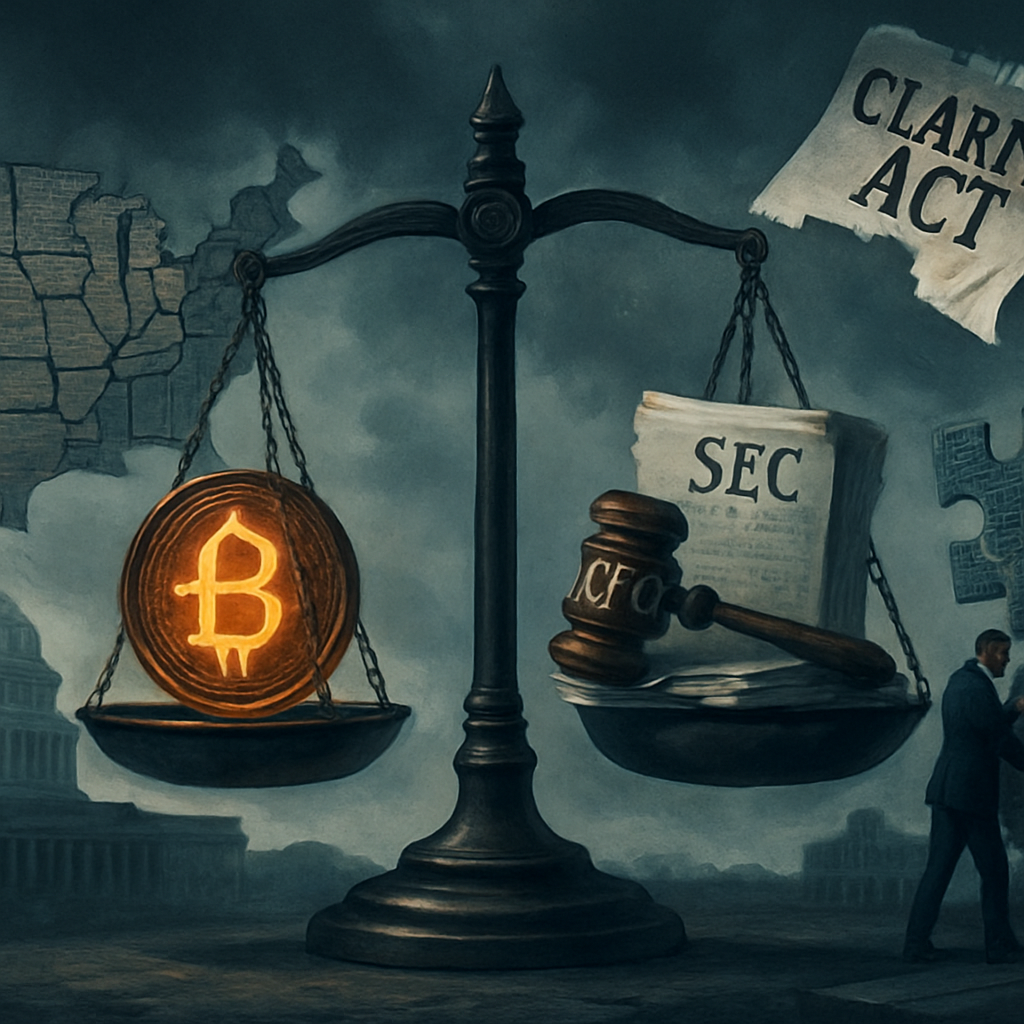
Prospects for near-term U.S. crypto policy remain uncertain as expectations that regulators would act if the proposed Clarity Act stalled now appear at risk of delay as well, leaving the industry with few immediate pathways to new rules.

What the Clarity Act Is Aimed to Do

The Clarity Act is a proposed bill intended to provide more definitive guidance for digital assets, including how tokens are classified and which agencies have primary oversight. Supporters say such legislation could establish clearer boundaries between securities and commodities regulation, streamline compliance for crypto firms, and offer more consistent protections for market participants.

Legislative Path Remains Uncertain

The bill’s timeline is unclear amid competing legislative priorities and a busy political calendar. Market participants had anticipated that, if Congress did not advance the measure, federal regulators might use existing authorities to offer additional guidance or rulemaking for digital assets.

Regulatory Action May Also Slow

Those expectations now face uncertainty as well. Agencies such as the Securities and Exchange Commission (SEC), the Commodity Futures Trading Commission (CFTC), and other financial regulators could wait for additional direction from Congress before finalizing new crypto-related policies. Any substantial rulemaking typically requires lengthy proposal and comment periods, suggesting that material changes may take time even if regulators proceed.

Implications for the Crypto Market

Without new legislation or agency guidance, the status quo is likely to persist, maintaining a patchwork of enforcement actions, court rulings, and existing guidance to set de facto standards. Companies may continue to adjust product offerings, compliance programs, and market footprints in response to evolving case law and supervisory priorities. Industry stakeholders are expected to keep pressing for statutory clarity while monitoring potential regulatory updates and the legislative calendar for signals on timing.

Ninth Circuit Expands CFTC Reach: Crypto Futures on Foreign Platforms Fall Under U.S. Jurisdiction

Wellermen Image Court Slaps Crypto Trader with Commodity Fraud Ruling

The Ninth Circuit just told a cryptocurrency futures trader he cannot hide behind corporate forms to dodge CFTC enforcement. In a terse, precedent-setting opinion, the appeals court upheld a massive civil penalty and permanent trading ban against James Devlin Crombie, marking the first time the circuit has squarely ruled that crypto futures fall under CFTC jurisdiction even when traded on foreign exchanges.

The case began when the CFTC accused Crombie of operating a Ponzi scheme that lured investors with promises of 10-15 percent monthly returns from Bitcoin and gold futures. After the scheme collapsed, the Commission sued Crombie personally, piercing the veil of his Cayman Islands entity and seeking both restitution and a trading ban. The district court granted summary judgment, finding Crombie liable for fraud, misappropriation, and operating an unregistered futures commission merchant. Crombie appealed, arguing the CFTC lacked authority over his foreign futures activity and that he was shielded by the corporate form.

Writing for a unanimous panel, Judge Sandra Segal Ikuta held that the Commodity Exchange Act’s broad anti-fraud provisions reach “off-exchange” futures offered to U.S. persons, regardless of where the trades clear. The court also rejected Crombie’s corporate-veil defense, finding he used the entity as an alter ego to perpetrate fraud. The panel affirmed the lower court’s $2.1 million restitution order and lifetime trading prohibition, effectively ending Crombie’s market access.

In plain English, the ruling means the CFTC can pursue anyone who solicits U.S. customers for futures-style crypto products, even if the contracts trade offshore and the operator hides behind an LLC. Foreign platforms courting American money now face the same disclosure, registration, and anti-fraud rules that govern domestic exchanges.

For crypto markets, the decision widens the CFTC’s net without touching the SEC’s turf, sharpening the divide between “commodity” derivatives and security tokens. Offshore exchanges that offer leveraged Bitcoin contracts will need tighter KYC and marketing controls, while DeFi protocols promising yield on synthetic futures face elevated enforcement risk. Traders relying on foreign venues for anonymity may find U.S. margin calls replaced by subpoenas.

The message is clear: if you touch U.S. futures money, the CFTC will treat you like a domestic player—corporate passports no longer optional.

Court Grants IRS Power to Seize Crypto Without Warrants in Civil Forfeiture Ruling

Wellermen Image Court Hands IRS Power to Seize Crypto Without Warrants

A federal judge just gave the IRS the green light to seize twenty-four cryptocurrency accounts based solely on a civil forfeiture complaint, not criminal charges. The ruling matters because it shows how quickly digital assets can be taken in tax investigations even when no one has been charged with a crime.

The IRS and Justice Department filed a civil forfeiture action against the accounts after tracing them to a taxpayer who allegedly failed to report income from cryptocurrency trading. Rather than wait for a criminal case or seek a warrant, the government asked the court to let it seize the wallets under a lower civil standard that only requires showing probable cause of tax evasion. The account holder fought back, arguing that seizing crypto should trigger the same Fourth Amendment protections as raiding a bank account or home. Judge Dabney L. Friedrich rejected that claim, holding that civil forfeiture of digital property needs only a sworn complaint and notice, not a warrant signed by a judge.

The decision tilts power toward the government at the exact moment when crypto markets are pushing for clearer rules and friendlier oversight. Exchanges now face the risk that customer wallets could be frozen on the strength of an IRS agent’s affidavit rather than a criminal indictment. DeFi protocols that allow pseudonymous transfers may find themselves in the crosshairs if the IRS can treat every wallet as forfeitable property first and figure out ownership later. Traders who keep large positions on U.S.-based platforms may start routing funds offshore or into self-custody just to avoid a surprise seizure that could tie up assets for months or years.

The ruling lowers the bar for the IRS to reach into digital wallets, turning what many hoped would be a regulated market into a potential minefield for anyone with reportable gains and an unpaid tax bill.

Plain-English translation: The IRS can now grab crypto the same way it grabs cash or cars in a civil tax case—without proving guilt beyond a reasonable doubt and without a warrant. That means faster freezes, longer legal fights, and higher compliance costs for anyone the agency decides to target.

For traders the message is blunt: treat every exchange withdrawal like it could be your last for a while, and price in the risk that a tax dispute could lock up liquidity without warning.

Judge Dismisses Broad SEC Claims Against Binance, Forcing Narrow Refile

Wellermen Image SEC Suffers Major Procedural Blow in Binance Case

The U.S. District Court for the District of Columbia just handed the Securities and Exchange Commission a sharp reminder that it cannot bulldoze defendants with vague complaints. In a blistering order, Judge Amy Berman Jackson dismissed much of the SEC’s case against Binance Holdings, ruling that the agency’s allegations were too thin to survive even the earliest stage of litigation. The decision matters because it signals that the Commission’s aggressive campaign against crypto exchanges may face real judicial pushback when its pleadings lack specificity.

The lawsuit began when the SEC sued Binance and its founder Changpeng Zhao last summer, claiming the platform operated an unregistered national securities exchange and offered unregistered securities through dozens of tokens. Binance fought back with a motion to dismiss, arguing the complaint failed to identify which tokens were securities, how U.S. users were targeted, or why Binance should be treated as a domestic exchange. Judge Jackson agreed on several fronts, finding the agency had not met its basic obligation to plead facts that plausibly connect Binance’s conduct to violations of U.S. securities laws.

The court dismissed claims tied to Binance’s global operations and refused to treat every token on the platform as a security without individualized analysis. It also rejected the SEC’s attempt to hold Binance responsible for secondary sales of tokens merely because the exchange listed them. The judge left the door open for the SEC to refile a narrower complaint focused on specific tokens and U.S.-facing conduct, but the broad theory that a foreign exchange automatically becomes subject to SEC jurisdiction by serving American customers took a direct hit.

In plain terms, the ruling forces the SEC to show its work. Instead of relying on sweeping assertions that “crypto is securities,” the agency must now identify particular tokens, transactions, and U.S. investor contacts. That raises the bar for enforcement actions and gives exchanges a clearer roadmap for what conduct crosses the line.

For crypto markets, the decision tilts power toward platforms that keep customer assets offshore and limit U.S. marketing. It weakens the SEC’s leverage in settlement talks and may embolden other defendants to challenge complaints that treat every token alike. Stablecoins and exchange tokens face renewed scrutiny, but only if the SEC can plead concrete facts linking them to investment contracts. Traders and liquidity providers gain breathing room; exchanges gain negotiating leverage.

The message is simple: the SEC’s crypto crackdown just became more expensive and less certain.

×