Judge Dismisses Broad SEC Claims Against Binance, Forcing Narrow Refile

Wellermen Image SEC Suffers Major Procedural Blow in Binance Case

The U.S. District Court for the District of Columbia just handed the Securities and Exchange Commission a sharp reminder that it cannot bulldoze defendants with vague complaints. In a blistering order, Judge Amy Berman Jackson dismissed much of the SEC’s case against Binance Holdings, ruling that the agency’s allegations were too thin to survive even the earliest stage of litigation. The decision matters because it signals that the Commission’s aggressive campaign against crypto exchanges may face real judicial pushback when its pleadings lack specificity.

The lawsuit began when the SEC sued Binance and its founder Changpeng Zhao last summer, claiming the platform operated an unregistered national securities exchange and offered unregistered securities through dozens of tokens. Binance fought back with a motion to dismiss, arguing the complaint failed to identify which tokens were securities, how U.S. users were targeted, or why Binance should be treated as a domestic exchange. Judge Jackson agreed on several fronts, finding the agency had not met its basic obligation to plead facts that plausibly connect Binance’s conduct to violations of U.S. securities laws.

The court dismissed claims tied to Binance’s global operations and refused to treat every token on the platform as a security without individualized analysis. It also rejected the SEC’s attempt to hold Binance responsible for secondary sales of tokens merely because the exchange listed them. The judge left the door open for the SEC to refile a narrower complaint focused on specific tokens and U.S.-facing conduct, but the broad theory that a foreign exchange automatically becomes subject to SEC jurisdiction by serving American customers took a direct hit.

In plain terms, the ruling forces the SEC to show its work. Instead of relying on sweeping assertions that “crypto is securities,” the agency must now identify particular tokens, transactions, and U.S. investor contacts. That raises the bar for enforcement actions and gives exchanges a clearer roadmap for what conduct crosses the line.

For crypto markets, the decision tilts power toward platforms that keep customer assets offshore and limit U.S. marketing. It weakens the SEC’s leverage in settlement talks and may embolden other defendants to challenge complaints that treat every token alike. Stablecoins and exchange tokens face renewed scrutiny, but only if the SEC can plead concrete facts linking them to investment contracts. Traders and liquidity providers gain breathing room; exchanges gain negotiating leverage.

The message is simple: the SEC’s crypto crackdown just became more expensive and less certain.

– Bitcoin News: Public Company Controls 20% of Ethena ENA Supply – Public Company Controls 20% of Ethena ENA Supply – Public Company Quietly Controls 20% of Ethena ENA – Ethena ENA: Public Company Holds 20% of Supply – Public Company Holds 20% of Ethena ENA Supply Want it with a different tone (urgent, neutral, or playful)?

StablecoinX Inc. disclosed that it holds approximately 3 billion ENA tokens—about 20% of the token’s total supply—shortly after completing its merger with TLGY Acquisition and listing on Nasdaq under the ticker USDE. The New York-based company reported the position in its results for the quarter ended June 30.

3 Billion ENA Position

According to the company’s quarterly disclosure, StablecoinX controls a stake of roughly 3 billion ENA tokens. The holding represents about one-fifth of the token’s supply, underscoring a significant concentration of digital assets on the firm’s balance sheet.

Nasdaq Listing via SPAC Merger

StablecoinX began trading on Nasdaq as “USDE” on June 26, following the closing of its merger with special purpose acquisition company TLGY Acquisition. The transaction provided the company with a public listing route and came one day prior to the start of trading.

Key Dates and Figures

  • ENA holdings: approximately 3,000,000,000 (≈20% of supply)
  • Quarter reported: three months ended June 30
  • Public listing: Nasdaq, ticker USDE
  • Listing date: June 26
  • Transaction: merger with TLGY Acquisition

Delaware Chancery Becomes Default Arena for Crypto Token-Control Fights

Wellermen Image Court Slaps Delaware Crypto Startup, Sends Case to Chancery

Diamond Fortress Technologies and its founder Charles Hatcher II just lost their home-court advantage in Delaware Superior Court. The three-sentence ruling remands their entire dispute to the Court of Chancery, signaling that Delaware’s business judges see the fight as an equity matter, not a contract spat. For crypto watchers, that matters because Chancery has become the de-facto venue for governance fights and token disputes.

The case began when Diamond Fortress, a Delaware company building biometric blockchain authentication, accused former partners of misusing code and investor funds. Hatcher sued for breach of contract, conversion, and related torts. Defendants moved to dismiss, arguing the claims belonged in Chancery because they sought equitable relief and turned on fiduciary duties. Superior Court Judge Paul R. Wallace agreed, ruling that the complaint’s core request—an injunction to stop further use of the technology—required equitable jurisdiction. The court rejected the plaintiffs’ attempt to “dress up” Chancery claims in contract clothing.

The practical result is simple: the case now lands before a Chancery judge who routinely handles corporate-control fights and may apply stricter fiduciary standards to crypto founders. That shift increases litigation costs, lengthens timelines, and raises the odds that the company’s governance documents and token-holder rights will be scrutinized under Delaware’s investor-friendly precedents. It also puts precedent-setting pressure on how Delaware treats blockchain-based assets when fiduciary claims intersect with code.

In plain English, Delaware just told a crypto startup that if you want to enjoin someone from using your tech, you argue in the equity court, not the contract court. That raises the bar for plaintiffs hoping to win quick injunctions without proving traditional fiduciary breaches. For founders, it means any promise of “code is law” can still be second-guessed by Chancery judges who see tokens as equity in disguise.

For the market, the decision quietly tightens the noose around Delaware’s reputation as crypto’s friendly courthouse. If Chancery keeps pulling DeFi governance disputes into its orbit, exchanges and DAOs that incorporated here will face longer, more expensive litigation and potentially tighter fiduciary exposure for insiders. Traders pricing governance tokens should start baking in that litigation overhang, especially for projects with Delaware LLCs or incs.

Bottom line: Delaware’s Chancery is becoming the default battleground for token-control fights; founders who forget that are writing tomorrow’s expensive precedent.

Grayscale Victory Clamps SEC, Clear Path for Spot Bitcoin ETF

Wellermen Image Court Slams SEC for Spot-Bitcoin ETF Double Standard

Grayscale won a landmark victory that forces the SEC to defend why it green-lights futures-based Bitcoin ETFs while rejecting the spot version of the same product. The D.C. Circuit found the agency’s denial of Grayscale’s GBTC conversion was arbitrary and capricious, giving crypto exchanges and funds renewed hope that spot products can finally reach U.S. investors.

Grayscale sued after the SEC rejected its 2021 application to convert the world’s largest Bitcoin trust into an exchange-traded fund. The firm argued that a spot ETF holding actual Bitcoin would be materially identical—in risk, surveillance, and manipulation resistance—to the futures-based ETFs the Commission had already approved. A three-judge panel agreed, ruling that the SEC failed to explain why the same underlying asset, just packaged differently, warranted opposite outcomes.

The court vacated the SEC’s order and sent the application back for fresh review. In practical terms, Grayscale now has leverage to push its product through, and the Commission must either approve it or provide a coherent, evidence-based distinction between spot and futures structures. Rivals such as BlackRock and Fidelity, which filed their own spot-ETF applications, stand to benefit from any precedent that narrows the SEC’s discretion.

In plain English, the decision tells the SEC it cannot treat similar products differently without a compelling reason, tightening the legal leash on the agency’s historically broad anti-crypto stance. Spot Bitcoin ETFs could soon trade alongside gold and equity funds, removing a major friction for institutions that want exposure without holding private keys.

For markets, the ruling shifts power away from the Commission’s policy preferences and toward judicial oversight, raising the odds that a spot ETF launches within months. That would likely pull billions into compliant products, ease pressure on offshore exchanges, and reduce the premium/discount volatility that has plagued Grayscale’s own trust. Stablecoin issuers and DeFi protocols may still face separate battles, but the precedent weakens the SEC’s ability to blanket-block mainstream crypto vehicles.

Investors should watch for an SEC appeal or a swift approval; either path signals that spot Bitcoin exposure is edging closer to regulatory legitimacy.

Seventh Circuit Expands CFTC Reach: Crypto Fundraisers Now Regulated as Commodity Pools

Wellermen Image Court Expands CFTC Reach Over Crypto Traders

The Seventh Circuit just handed the CFTC a victory that widens the agency’s grip on crypto trading platforms, ruling that even unregistered individuals who facilitate derivatives-like bets on digital assets can be treated as commodity pool operators. The decision matters because it signals that courts are willing to stretch existing futures law to cover novel crypto structures, giving regulators a powerful new tool without waiting for Congress.

The lawsuit began when the CFTC accused James Donelson of running an unregistered commodity pool after he solicited investors for a trading operation that used customer funds to buy and trade Bitcoin futures contracts. Donelson argued that because he never touched actual futures himself, and only traded spot Bitcoin, he fell outside the CFTC’s statutory reach. The district court rejected that defense and granted summary judgment; Donelson appealed, claiming the agency lacked jurisdiction over what he portrayed as a simple cryptocurrency venture.

Judges in Chicago sided with the CFTC, holding that Donelson’s solicitation of funds for a pooled trading account keyed to the price of Bitcoin futures made him a commodity pool operator under the Commodity Exchange Act—even though the actual futures trading was executed by another party. The court emphasized that the statute targets anyone who accepts money with the understanding that it will be used to trade regulated instruments, regardless of whether that person places the trades. Donelson therefore must register, disclose risks, and comply with CFTC oversight; his failure to do so leaves him exposed to fines and restitution orders.

In plain English, the ruling tells crypto entrepreneurs that if customer money ends up in futures or other CFTC-regulated derivatives, the person who gathered the money can be regulated like a hedge-fund manager. It lowers the bar for enforcement actions, letting the agency pursue cases based on the intended use of funds rather than on who physically pressed the “buy” button.

For markets, the decision tilts power toward the CFTC at the expense of DeFi builders and offshore exchanges that route U.S. customer funds into derivatives. Spot-Bitcoin trading venues now face a gray-zone risk: if any portion of their flow touches regulated futures—or if marketing materials suggest such exposure—operators could be swept into the same registration net. Traders who rely on lightly regulated platforms may see tighter KYC, higher compliance costs, and fewer offshore options willing to serve Americans. Stablecoin issuers and lending protocols that collateralize positions with futures gain an added layer of regulatory scrutiny.

The takeaway: crypto firms can no longer assume that touching only spot markets shields them from CFTC oversight; if futures are in the mix, registration is the safer bet.

Saylor: Bitcoin Dips 47% as STRC Rises 9% in a Year

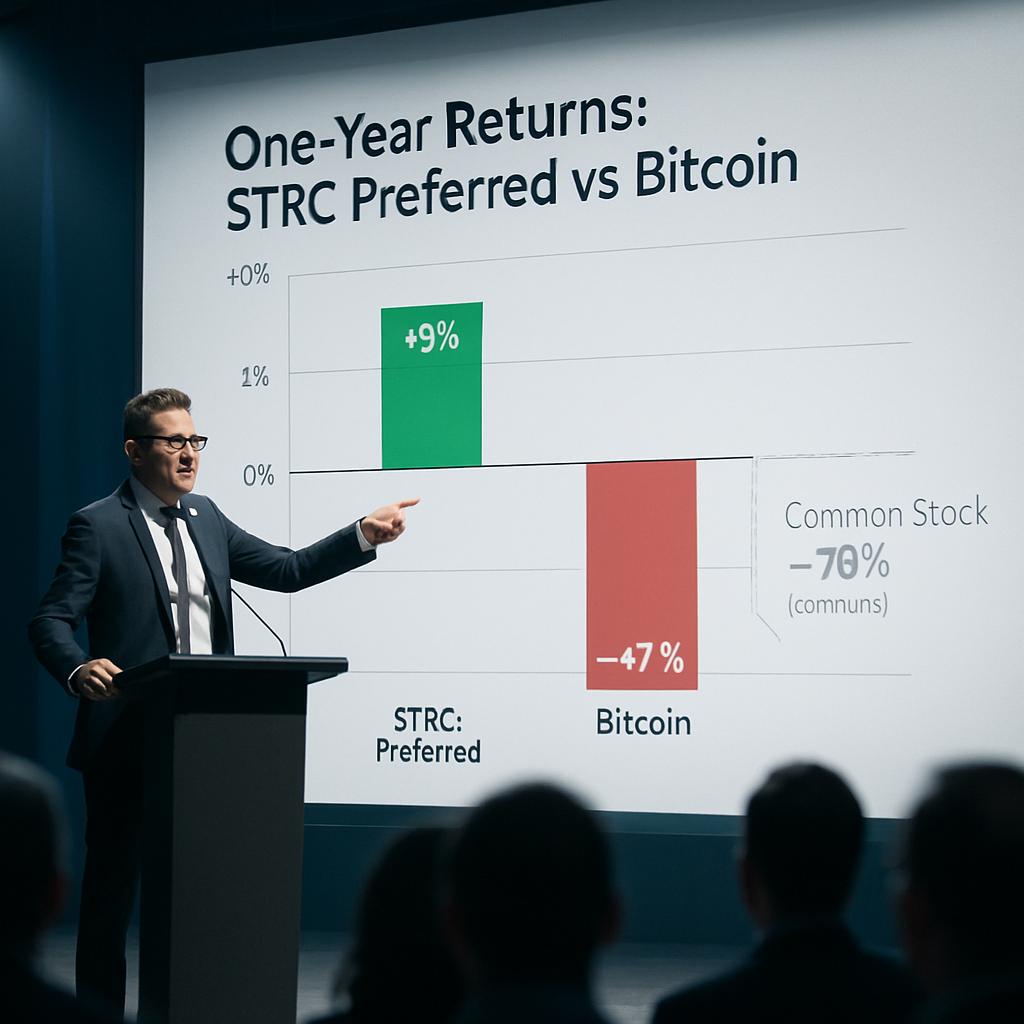
Michael Saylor highlighted a one-year return comparison showing the company’s STRC preferred stock up 9% while bitcoin fell 47% over the same period. The presentation omitted the company’s common stock, which finished roughly 76% below its level a year earlier.

STRC Preferred Outperforms as Bitcoin Declines

According to Saylor, the STRC preferred security gained 9% over the past year, outpacing bitcoin by 56 percentage points based on a one-year return snapshot. The comparison underscores how fixed-income-like securities can hold up differently from highly volatile assets such as bitcoin during drawdowns.

Common Shares Not Reflected in Chart

The chart cited did not include the company’s common equity performance. Over the same one-year window, the common stock closed approximately 76% lower year-over-year, highlighting a significant divergence between the company’s preferred and common securities.

Context: Preferred vs. Common and Market Conditions

  • Preferred stock typically offers dividends and priority over common shares in the capital structure, which can cushion price declines relative to common equity in adverse markets.
  • Common shares generally carry higher risk and potential upside but can be more sensitive to company fundamentals, liquidity needs, and broader market sentiment.
  • Bitcoin’s one-year decline in the cited period reflects the asset’s characteristic volatility. Performance comparisons can vary widely depending on the selected timeframe.

Third Circuit Keeps SEC in the Driver’s Seat on Crypto Listings; Coinbase Rulemaking Bid Denied

Wellermen Image Court Slams Coinbase: SEC Keeps Full Control Over Crypto Listings


The Third Circuit just handed the SEC a decisive win by refusing to force the agency to clarify exactly when a crypto token becomes a security. Coinbase wanted a rule. The court said the agency can keep the status quo. That means the SEC retains the power to decide case-by-case whether exchanges are breaking the law by listing tokens that might be unregistered securities.

The dispute began when Coinbase petitioned the Commission under the Administrative Procedure Act to issue a formal rule defining how the Howey test applies to digital assets. The SEC denied the petition, arguing that existing precedent already covers crypto and that a new rule would be premature while enforcement actions are pending. Coinbase appealed, claiming the agency’s refusal was arbitrary and left the industry in regulatory limbo. A three-judge panel disagreed, holding that the Commission’s decision not to launch a rulemaking was within its discretion and not subject to second-guessing by the courts.

In plain English, the ruling tells exchanges and token issuers that they cannot force the SEC’s hand; they must live with enforcement risk until Congress or the Commission decides otherwise. The agency can continue to bring individual actions without first spelling out the boundaries, giving it maximum leverage in negotiations and settlements.

For markets, the decision cements the SEC’s authority to treat most tokens as securities, raising compliance costs for exchanges and DeFi protocols that must either delist suspect assets or brace for litigation. Stablecoin issuers and trading platforms face heightened scrutiny, while traders may see reduced liquidity in marginal tokens. The ruling also tilts power away from industry calls for clear rules and toward enforcement-first regulation, increasing uncertainty that historically breeds both caution and opportunistic legal arbitrage.

Until lawmakers step in, every new token listing carries litigation risk that only the SEC gets to price.

DefiLlama Delays Mobile Launch Over Apple App Store Phishing Apps

DefiLlama has delayed the release of its mobile app after discovering phishing lookalikes on Apple’s App Store, according to the company’s founder. Apple removed at least one fraudulent app within days after DefiLlama documented that it had drained funds from a small crypto wallet, the founder said.

Fake App Removed After Report

The founder said the team identified a counterfeit app impersonating DefiLlama and provided evidence to Apple that the app had extracted funds from a small wallet. Apple removed the listing within days of receiving the report, according to the account.

Phishing apps often mimic well-known crypto brands to solicit seed phrases or prompt malicious transactions, allowing attackers to access user funds.

Mobile Launch Paused

DefiLlama, a widely used decentralized finance analytics platform that tracks total value locked (TVL) across protocols and chains, has delayed its mobile launch amid the appearance of lookalike apps. The company signaled it would prioritize user safety and clarity around the official app before proceeding.

Imitation Apps Remain a Risk

Crypto-related apps on mainstream marketplaces have been recurring targets for impersonation, creating risks for users who may download fraudulent software that requests sensitive information or executes unauthorized on-chain actions. App store reviews can mitigate these issues, but malicious listings may still appear temporarily.

How users can reduce risk

  • Download apps only from links on the project’s official website or verified social channels.
  • Verify the developer name, publication date, and app history before installing.
  • Be wary of requests for seed phrases or private keys—legitimate apps do not ask for them.
  • Review recent user feedback for warnings about phishing or unauthorized transactions.

Here are punchy, under-12-word options: – Bitcoin News: Roman Storm Targets Google, OpenAI Over DOJ Conviction – Roman Storm Targets Google, OpenAI Over DOJ Crypto Conviction – Crypto Conviction: Roman Storm Targets Google and OpenAI – Roman Storm Targets Google and OpenAI Over DOJ Crypto Conviction

Roman Storm, co-founder of the Tornado Cash privacy protocol, criticized the legal theory behind the U.S. case against him, arguing that by the same logic, mainstream technology companies such as Google and OpenAI could be held liable if sanctioned actors misuse their tools. His comments, posted on X, come amid an ongoing legal battle that could shape how courts treat developer responsibility for open-source software used in illicit activity.

Storm Challenges Prosecutors’ Theory of Liability

Storm argued that the government’s approach to Tornado Cash is overly broad and inconsistent. He contended that if developers can be held responsible for autonomous software later used by sanctioned entities, then other platforms whose products are used by North Korean operatives could face similar exposure. He cited Google and OpenAI as examples to illustrate what he called a flawed standard for liability.

U.S. officials have long asserted that cyber theft and sanctions evasion help finance North Korea’s weapons programs. Storm’s remarks position the Tornado Cash case within a larger debate over whether toolmakers should be accountable for how bad actors use widely available technologies.

Background: Tornado Cash, Sanctions, and the DOJ Case

Tornado Cash is an Ethereum-based privacy tool that uses smart contracts to obscure transaction trails, enhancing on-chain anonymity. In August 2022, the U.S. Treasury’s Office of Foreign Assets Control (OFAC) sanctioned Tornado Cash, alleging it was used to launder funds tied to cyberattacks, including thefts attributed to North Korea’s Lazarus Group.

In 2023, the U.S. Department of Justice charged Storm and others with conspiracy offenses related to money laundering, sanctions violations, and operating an unlicensed money-transmitting business. Prosecutors allege the protocol facilitated the laundering of illicit proceeds, including funds connected to state-sponsored hacking. Defense arguments have emphasized Tornado Cash’s open-source, non-custodial design and the limits of developer control once smart contracts are deployed.

Broader Debate on Developer Responsibility

The case has become a focal point for the crypto industry and open-source advocates concerned about the precedent it could set for software authors whose code is later misused. It also intersects with ongoing policy questions about financial privacy, sanctions enforcement, and the extent to which decentralized protocols can or should incorporate controls against illicit finance.

What to Watch

  • How courts weigh the distinction between creating autonomous software and operating a money service.
  • Whether liability theories extend to other technology providers when sanctioned entities use general-purpose tools.
  • Potential policy or regulatory responses that balance privacy, innovation, and sanctions compliance in decentralized finance.

Bitcoin News: Police Probe Substance Abuse in Harry Yeh’s Death

Paraguayan authorities are investigating the death of prominent cryptocurrency investor Harry Yeh, who died on August 7 after a fall from the 30th floor of the Jade Park residential building. Preliminary autopsy findings and statements from building workers are being reviewed as police assess whether foul play was involved.

Investigation Underway

Police in Paraguay continue to examine the circumstances surrounding Yeh’s death. Officials have taken statements from workers at the Jade Park building and are analyzing autopsy results to determine the sequence of events leading up to the incident.

Autopsy and Witness Accounts

Authorities have indicated that the autopsy results, combined with witness accounts from building staff, may offer insight into what transpired on August 7. As of publication, investigators have not publicly confirmed whether they suspect foul play.

About Harry Yeh

Yeh was a well-known figure in the digital asset sector and has been described in reports as a “$2 billion crypto investor.” His death has drawn significant attention from the cryptocurrency community, given his profile and influence in the industry.

What Happens Next

The investigation remains active. Further details are expected as police complete their review of the autopsy findings and witness statements. Officials have urged the public to await verified updates from the authorities.

Public Miners Shed 21% Bitcoin Hashrate as AI Revenue Accelerates

Publicly listed bitcoin miners have reduced their collective share of the Bitcoin network’s computing power by 21% in recent months as demand for artificial intelligence and high‑performance computing (HPC) accelerates. Operators are reallocating power capacity, data center space, and capital toward GPU-driven workloads that are generating faster and more predictable revenue than bitcoin mining.

Miners Pivot Toward AI and HPC

Over the past quarter, multiple North American mining firms have dismantled or repurposed parts of their bitcoin mining fleets to support AI and HPC infrastructure. While application-specific integrated circuits (ASICs) used for bitcoin cannot perform AI tasks, miners are converting facilities—power delivery, racking, cooling, and networking—to host GPU clusters for AI training and inference.

The shift is driven by robust demand for compute from AI developers and enterprises, which has created strong pricing and the potential for multi‑year hosting contracts. For miners facing revenue volatility tied to bitcoin price cycles, long-term AI/HPC agreements can enhance cash-flow visibility and improve return on invested capital for existing energy and data center assets.

Impact on Network Dynamics and Miner Economics

The 21% drop reflects a decline in the share of hashrate attributable to publicly traded miners, not an equivalent reduction in the Bitcoin network’s total hashrate. As public operators pivot capacity, privately held miners and international participants may absorb a larger portion of network computing power.

Bitcoin miner economics have tightened following the most recent block subsidy halving, which reduced issuance rewards by 50%. Combined with elevated energy costs in some regions and a competitive hardware cycle, the halving has pushed operators to optimize margins. Diversifying into AI/HPC can lift revenue per megawatt compared with bitcoin mining, depending on contract terms, utilization, and power markets.

What Is Being Repurposed

Miners are not converting ASIC machines into AI hardware. Instead, they are:

  • Redeploying power infrastructure and data center space to host GPU servers.
  • Upgrading cooling, networking, and security to meet AI/HPC requirements.
  • Pursuing long-term hosting or compute‑as‑a‑service contracts with AI clients.

This reconfiguration typically requires new capital for GPUs and supporting infrastructure, as well as lead times for procurement, permitting, and interconnection upgrades.

Outlook

Key variables to watch include miners’ monthly production updates, changes in public miners’ share of network hashrate, AI/HPC contract backlogs, GPU supply availability, and regional power prices. The pace of AI demand growth, together with regulatory and grid constraints, will influence how quickly bitcoin miners can expand HPC services and how the composition of the Bitcoin network evolves.

– SEC Reviews Cboe’s Bid to List 3x Bitcoin and Ether ETFs – SEC Evaluates Cboe’s Bid to List 3x BTC and ETH ETFs – Cboe Seeks 3x Bitcoin, Ether ETFs; SEC Reviews Bid

U.S. investors could soon see new triple-leveraged bitcoin and ether funds on the market after Cboe filed a proposal to list six leveraged commodity products designed to deliver three times each asset’s daily performance. The U.S. Securities and Exchange Commission (SEC) now faces an initial 45-day window from Federal Register publication to approve, disapprove, or open proceedings to consider the rule change.

Triple-Leveraged Bitcoin and Ether Products Proposed

Cboe’s filing seeks approval to list six exchange-traded products that aim to provide 3x exposure to the daily price movement of bitcoin (BTC) and ether (ETH). Each product would be calibrated to a single trading day, meaning performance goals are reset daily and may diverge from the underlying asset’s longer-term returns due to compounding effects.

Leveraged exchange-traded products are commonly used by active traders to express short-term views. While they can amplify gains, they also magnify losses and are generally considered unsuitable for buy-and-hold strategies.

SEC Review Timeline

Under the Securities Exchange Act, the SEC initially has 45 days from the date the proposal is published in the Federal Register to issue a decision or initiate proceedings that could extend the review. The agency can lengthen the evaluation period, potentially up to several months, before reaching a final determination.

Context: Expanding U.S. Crypto ETP Lineup

The proposal arrives as U.S. markets have broadened access to crypto exposure through exchange-traded products. Spot bitcoin and ether ETFs began trading in 2024, and futures-based funds have been available since earlier years. Introducing triple-leveraged products tied to the daily performance of BTC and ETH would further expand the toolkit available to sophisticated traders seeking amplified, short-term exposure.

Why It Matters

  • Broader market access: Approval would add higher-octane options for traders looking to express directional views on BTC and ETH within a regulated exchange framework.
  • Higher risk profile: Daily rebalancing and 3x leverage increase volatility and tracking differences over multi-day periods, underscoring the products’ short-term focus.
  • Regulatory signal: The SEC’s decision will offer another data point on how the agency approaches leveraged crypto-linked products following the rollout of spot crypto ETFs.

The SEC’s notice in the Federal Register will start the formal clock for review. Market participants will be watching for the agency’s response and any public comment period that could shape the final outcome.

– Binance Ends Transactions on 16 Platforms; Wallet Reviews Warn – Bitcoin News: Binance Ends 16-Platform Transactions, Wallet Reviews Warn – Binance Halts Transactions Across 16 Platforms; Wallet Reviews Warn

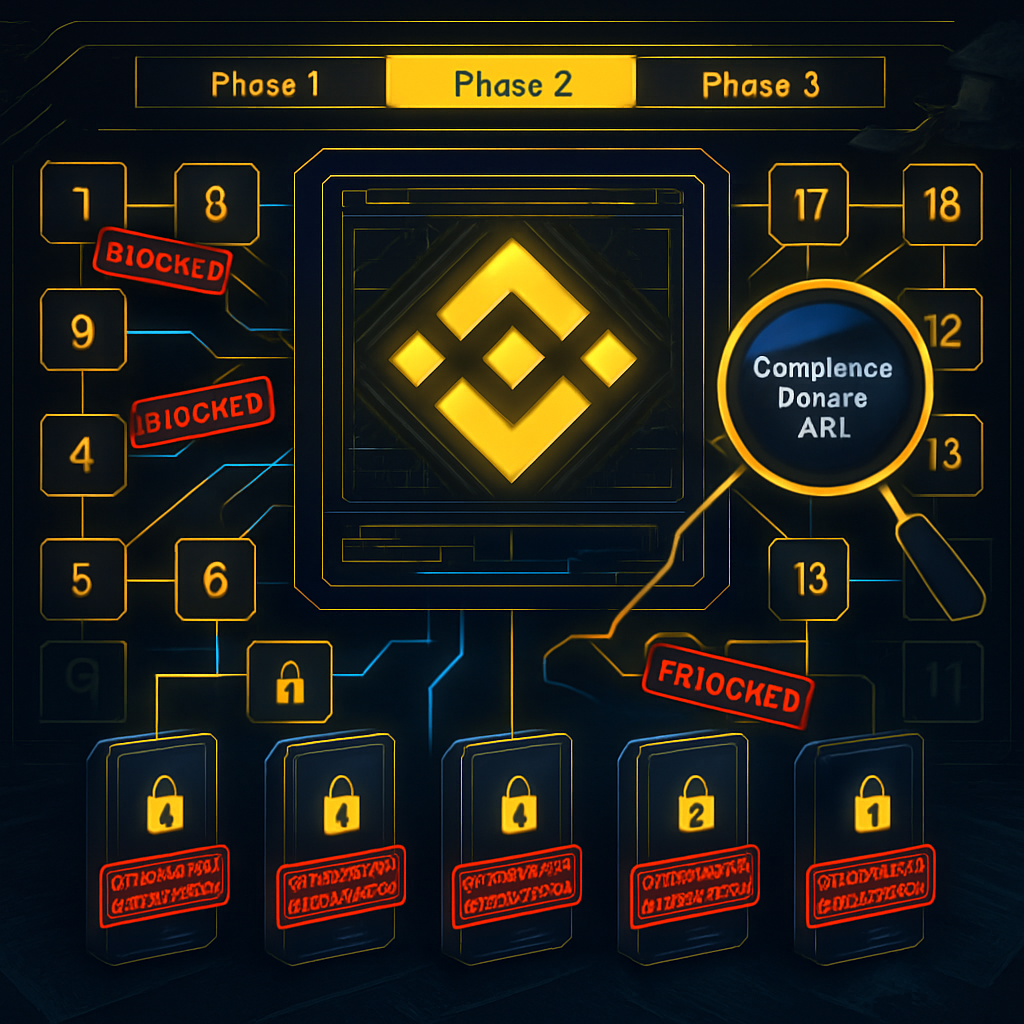
Binance will stop processing transactions involving 16 external crypto platforms, citing regulatory developments. The exchange said transfers attempted after phased deadlines may be subject to compliance reviews and could trigger temporary restrictions on affected wallets.

Binance Sets Three Deadlines for Transaction Restrictions

In an announcement dated Aug. 14, Binance outlined that transactions to and from 16 crypto-asset service providers will no longer be processed on its platform. The changes will roll out in three stages, each with its own cutoff date. After each deadline, attempted transfers linked to the specified platforms may be flagged for review and face temporary limitations.

What the Restrictions Mean for Users

  • Transactions involving the designated third-party platforms will be blocked after the applicable cutoff dates.
  • Transfers attempted after those dates may undergo additional compliance checks.
  • Wallets associated with such transfers could face temporary restrictions during the review process.

Binance advised users to take note of the deadlines to avoid disruptions. The company did not disclose additional operational details in the announcement beyond the phased implementation and review process.

Regulatory Context

The move follows ongoing global regulatory scrutiny of crypto-asset service providers, particularly around anti-money laundering and counter-terrorist financing standards. Exchanges and custodians have been tightening controls to align with jurisdictional requirements and international frameworks such as the Financial Action Task Force’s recommendations on virtual asset service providers.

Next Steps

Users are encouraged to review counterparties they transact with and assess whether any fall under the new restrictions. Monitoring official Binance announcements and account notifications ahead of the staged deadlines can help minimize potential service interruptions.

Kalshi Wins Court Battle, Forcing CFTC to Allow Election Contracts

Wellermen Image Court Orders CFTC to Let Kalshi Trade Election Contracts

A federal appeals court just handed Kalshi a decisive win, forcing the CFTC to allow the exchange to list election contracts while regulators scramble to contain the fallout. The ruling undercuts the agency’s claim that political-event contracts are too risky for retail traders, signaling that courts may no longer defer to CFTC gatekeeping on what counts as a legitimate futures market.

The dispute started when the CFTC blocked Kalshi’s application to offer contracts that pay out on which party wins congressional control or the presidency. Agency staff argued these contracts could be manipulated, invite illegal gambling, and fail public-interest tests. Kalshi sued, claiming the CFTC had no statutory basis to reject a product that meets all core requirements for a futures contract. The D.C. Circuit sided with Kalshi on an emergency stay motion, finding the CFTC’s public-interest rationale unlikely to survive judicial scrutiny and that the exchange would suffer irreparable harm from lost revenue and market share.

Judges ruled the CFTC cannot simply assert risk without evidence, and that Congress never gave the agency blanket authority to veto contracts tied to elections. Kalshi wins the right to list the contracts immediately; the CFTC loses its de-facto veto power, at least until a full appeal plays out. Traders gain a new, regulated venue for political-event exposure, while traditional prediction platforms like PredictIt or Polymarket face fresh competition from a CFTC-supervised exchange.

The decision narrows the CFTC’s discretion to block novel contracts on subjective “public interest” grounds, forcing the agency to rely on concrete statutory violations instead. That shift weakens the regulator’s leverage over both event contracts and, potentially, other politically sensitive or data-driven products. Exchanges now have precedent to challenge similar blocks, and traders should expect more politically linked derivatives to clear regulatory hurdles.

This ruling tilts power toward exchanges and traders by treating election contracts as ordinary commodities, not moral hazards—watch for the CFTC to push Congress for explicit veto authority next.

Texas Court Narrows Regulator Reach in Crypto-Mining Case

Wellermen Image COURT SIDES WITH MINERS IN TEXAS POWER DISPUTE

A Texas appeals court just handed crypto miners a small but sharp victory over utility regulators, ruling that Envy Blockchain can’t be forced to disclose sensitive mining data in a civil suit. The Eighth District’s decision limits how far state authorities can reach into private blockchain operations — and it signals that courts may push back when regulators try to treat mining like a public utility.

The case started when Envy Blockchain and its affiliates were dragged into a lawsuit involving Texas power-grid disputes. State investigators wanted internal records on energy consumption, server locations, and revenue models. Envy refused, arguing the requests were overbroad and threatened trade secrets. The lower court sided with the state and ordered production. Envy then filed an emergency mandamus petition to the Eighth Court of Appeals, asking the higher bench to block the order.

In a unanimous opinion, the appellate panel held that the trial court abused its discretion. Judges found the requested documents were neither relevant nor necessary to the underlying claims, and that forcing disclosure would cause “irreparable harm” to Envy’s competitive position. The court stressed that mining operations do not automatically become state actors simply because they consume grid power. The ruling quashes the discovery order and sends a clear message: regulators need a tighter legal hook before they can rifle through a miner’s books.

Plainly, the decision narrows the state’s ability to use civil discovery as a back-door audit of crypto mining. It also raises the bar for any future attempt to classify mining facilities as “public utilities” simply because they draw megawatts. While the case is still at the pretrial stage, the precedent could ripple outward: other states watching Texas may hesitate before launching similar fishing expeditions.

For crypto markets, the win is modest but symbolic. It chips away at the narrative that mining is an inevitable target of aggressive oversight, and it could ease financing concerns for energy-intensive projects in pro-mining jurisdictions. Yet the ruling is narrow; it does not address broader questions of commodity status, exchange licensing, or stablecoin reserves. Traders should treat it as a tactical reprieve, not a regulatory shield.

Bottom line: courts can still slam the brakes on regulatory overreach, but only when miners keep their legal powder dry and their data tightly held.

×