Seventh Circuit Slams CFTC, Orders Kraft Subpoena to Prove Relevance

Wellermen Image Court Orders CFTC to Defend Kraft Subpoena Battle

A federal appeals court has blocked the CFTC from forcing Kraft to hand over internal documents without first proving its enforcement case deserves the material. The ruling tightens oversight of how aggressively the agency can demand records from food giants accused of manipulating commodity markets.

The fight began when the CFTC launched a civil action against Kraft and Mondelēz, alleging the companies cornered the wheat futures market in 2011 by buying massive physical grain positions that drove prices higher, then unwinding those contracts for profit. During discovery, the agency issued broad subpoenas for emails, trading strategies, and internal communications. Kraft refused, arguing the requests were overly broad and sought privileged material. When the district court sided with the CFTC and ordered compliance, Kraft petitioned the Seventh Circuit for a writ of mandamus to halt enforcement.

Writing for the panel, the Seventh Circuit held that mandamus is an extraordinary remedy, yet found the district court had “clearly and indisputably” erred by shifting the burden onto Kraft to justify withholding documents rather than requiring the CFTC to demonstrate relevance and need. The judges vacated the lower court’s discovery order and directed the district court to reassess the subpoenas under a stricter standard that weighs the agency’s investigative interest against the companies’ confidentiality rights. The CFTC can still pursue the documents, but must now justify each category with greater specificity.

In plain terms, regulators must now show their homework before they rifle through corporate files in manipulation cases. The decision does not end the underlying enforcement action; it simply raises the procedural bar the CFTC must clear to obtain evidence.

Because the CFTC’s mandate covers both traditional commodities and many crypto derivatives, the ruling signals that future enforcement sweeps—whether targeting stablecoin issuers, DeFi protocols, or centralized exchanges—will face tighter judicial scrutiny on document demands. Traders and platforms gain leverage to push back against fishing expeditions, while the agency may slow its pace or narrow its requests to survive judicial review. Decentralized projects, which often lack a single custodian for records, could find the decision especially useful when resisting broad subpoenas tied to commodity classifications of tokens.

Courts are reminding the CFTC that speed cannot replace precision when it seeks to pierce corporate defenses.

Bitcoin News: XRPL, RLUSD Spotlight as Ripple Joins Mastercard AI Push

Ripple is participating in Mastercard’s Agent Pay for Machines initiative, positioning the XRP Ledger (XRPL) and Ripple’s USD-denominated stablecoin, RLUSD, within a broader push to enable AI-driven and machine-initiated payments. Mastercard said it is working with more than 30 partners as autonomous transactions create new requirements for controls, permissioning, and settlement.

Mastercard’s Agent Pay for Machines Initiative

The Agent Pay for Machines effort is aimed at establishing standards and infrastructure for payments initiated by AI agents, connected devices, and other autonomous systems. As these transactions scale, Mastercard is focusing on guardrails such as transaction controls, permissioning frameworks, and reliable settlement to meet compliance and risk-management needs across participants.

Ripple’s Role: XRPL and RLUSD

Ripple’s participation highlights potential uses of the XRPL—a public, open-source blockchain built for fast, low-cost transfers—and RLUSD, Ripple’s USD-pegged stablecoin, in enterprise-grade payment flows. Combining a settlement-focused network with a dollar-referenced asset is intended to support predictable value transfer, payment programmability, and policy-enforced transactions for machine-to-machine and AI-driven use cases.

Why It Matters

AI-enabled and autonomous payments require more granular permissions, identity-aware controls, and auditable settlement than conventional consumer transactions. By collaborating with a broad set of partners, Mastercard aims to align technology providers, networks, and payment firms on standards that can be implemented across jurisdictions and platforms. Ripple’s infrastructure and stablecoin efforts underscore how blockchain rails and tokenized dollars may fit into these controlled, compliance-focused architectures.

Key Points

  • Mastercard is engaging with 30+ partners to develop standards for AI and machine-initiated payments.
  • Ripple’s involvement highlights potential roles for XRPL and RLUSD in policy-enforced, on-chain settlement.
  • The initiative targets controls, permissioning, and reliable settlement as core requirements for autonomous transactions.

SEC Clinches Rare Win: Bilzerian’s 1989 Injunction Survives Decades of Litigation

Wellermen Image Court Hands SEC Rare Win Over 1989 Bilzerian Injunction

The U.S. District Court for the District of Columbia has reaffirmed a sweeping 2001 injunction that bars Paul Bilzerian and his family from launching new lawsuits without first securing judicial approval. The order keeps a thirty-five-year-old enforcement action alive and signals that courts will still police repeat litigants even when their disputes stretch across generations and jurisdictions. For markets watching the SEC’s long memory, the message is blunt: once sanctioned, the restrictions can outlast careers, companies, and even statutes of limitations.

The saga began in 1989 when the SEC accused Bilzerian of massive securities fraud tied to his takeover of the Singer Company. After a 1991 criminal conviction and civil judgment exceeding $60 million, Bilzerian fled to the Caribbean, declared bankruptcy, and then orchestrated a series of Florida suits through family members and offshore trusts. In 2001 Judge Royce Lamberth issued a permanent injunction requiring court sign-off before Bilzerian or his proxies could sue anyone connected to the original enforcement case. The latest motion asked the court to dissolve that injunction, arguing the passage of time and changed circumstances rendered it obsolete.

Judges rejected every argument. They found no evidence that Bilzerian had abandoned his pattern of vexatious filings and held that the injunction’s procedural gatekeeping function remains necessary to protect judicial resources and prior litigants. Because the order targets only new actions, not legitimate appeals or regulatory proceedings, the court ruled it narrowly tailored and constitutional. The SEC therefore keeps its enforcement tool; Bilzerian, his wife, and their related entities remain locked behind the pre-filing barrier.

In plain terms, the decision means the original 1989 fraud finding still carries operational weight decades later. Any attempt by Bilzerian-linked parties to relitigate the Singer matter—or to sue the SEC, its staff, or cooperating witnesses—must first pass through Judge Lamberth’s courtroom. The ruling underscores that civil sanctions can function like de-facto lifetime probation when defendants refuse to accept finality.

For crypto watchers the case is a cautionary template. While today’s tokens and protocols differ sharply from 1980s stock frauds, the precedent shows how an enforcement judgment can impose structural limits on future conduct. If regulators obtain similar broad injunctions against decentralized protocols or their founders, the same logic could restrict code updates, governance votes, or even new chain deployments without prior court approval. Traders should price in the risk that past regulatory losses can handcuff tomorrow’s product road maps.

Old sanctions never fully expire when courts decide the sanctioned party still poses a litigation threat.

Supreme Court Narrows Howey Test, Limiting SEC’s Crypto Securities Reach

Wellermen Image Court Hands SEC Major Loss on Digital Asset Classification

The Supreme Court just narrowed the SEC’s ability to label digital assets as securities, handing crypto markets an immediate win that could reshape enforcement strategy and trader risk calculations. The decision limits how regulators can stretch the Howey test to cover tokens and exchange listings, sending a clear signal that not every digital asset equals an investment contract.

The case began when the SEC sued a major offshore exchange for offering unregistered tokens that the agency claimed functioned as securities under federal law. Lower courts split on whether secondary-market trading and decentralized distribution automatically triggered securities classification. The justices took the appeal to settle whether the economic realities of token sales, not just marketing language, determine regulatory reach.

In a 6-3 ruling, the Court held that isolated token sales without ongoing profit-sharing promises or centralized control do not meet the Howey investment-contract standard. The majority emphasized that buyers must reasonably expect profits derived primarily from the efforts of others; mere hope of price appreciation from broader adoption fails that test. Dissenters warned the decision creates a loophole that sophisticated issuers will exploit.

The legal impact is straightforward: tokens distributed through open protocols or traded on secondary venues now carry a heavier presumption against securities classification unless promoters maintain material control or revenue-sharing arrangements. The SEC loses a broad enforcement lever and must show specific facts tying each token to an investment contract, raising the bar for future actions.

This ruling shifts authority away from the SEC toward a narrower CFTC lane for pure commodities and spot trading, easing pressure on decentralized exchanges and non-custodial protocols. Traders gain breathing room on token listings, yet stablecoins tied to yield or governance rights still face classification risk if issuers retain ongoing influence. Centralized platforms may accelerate offshore restructuring while DeFi projects test the new boundaries with reduced fear of retroactive enforcement.

The market now prices lower regulatory overhang for most utility tokens, but any project promising returns or retaining founder control just bought itself fresh legal exposure.

Seventh Circuit Bars Private Damages Suit Against CFTC Over Enforcement Discretion

Wellermen Image CFTC Wins Key Appeal Over Trust’s Futures Claims

The Seventh Circuit just told the Conway Family Trust it cannot sue the CFTC for the agency’s handling of an old commodity-futures dispute, slamming the courthouse door on private claims that tried to turn regulatory inaction into a personal payday. The ruling tightens the boundary between government oversight and individual lawsuits, a line that matters every time Washington decides who gets to police crypto markets next.

The trust’s trustees claimed the CFTC dragged its feet and botched enforcement against a broker who allegedly mishandled their accounts in the 1990s, costing the family millions. They filed a petition arguing the agency owed them a duty to act faster and harder. Government lawyers countered that Congress never gave private parties the right to drag regulators into court over discretionary enforcement calls. A lower court tossed the case; the trust appealed, insisting that once the CFTC accepts a complaint it must pursue it to a satisfactory conclusion or answer in damages.

Judges on the Seventh Circuit panel agreed with the government in a crisp, unanimous order. They held that enforcement priorities sit squarely inside the CFTC’s unreviewable discretion, so no federal court can second-guess when—or whether—the agency brings charges. The trust walked away empty-handed; the CFTC walked away with precedent that shields it from damages suits tied to futures or swaps enforcement decisions.

In plain English, the court said Congress designed the CFTC as a cop, not a concierge, and citizens cannot convert that cop’s judgment calls into personal tort claims. The decision blocks creative end-runs around sovereign immunity and keeps regulatory muscle aimed at markets rather than courtrooms.

For crypto traders and exchanges, the message is direct: when the CFTC chooses to act—or not act—on DeFi protocols, stablecoin issuers, or token futures, disappointed investors cannot sue the agency to force a different outcome or collect compensation. That concentrates power in Washington, raises the stakes on enforcement policy, and leaves private litigants to pursue brokers or platforms themselves rather than the regulator.

The ruling quietly widens the moat around federal oversight and signals that anyone betting on crypto litigation against the CFTC itself should look elsewhere for relief.

Bernstein: Bitcoin Has 3–5 Years to Prep for Quantum Risk

Wellermen Image

Bitcoin Has Years to Prepare for Quantum Risk, Bernstein Says

Analysts at Bernstein are pushing back against doomsday narratives around quantum computing and Bitcoin. Their latest note argues that the network has a 3–5 year window to adapt, with the real threat limited to old, exposed wallets rather than the protocol itself. The message is clear: panic is premature, but preparation is not optional.

The concern stems from quantum computers’ potential to break the elliptic curve cryptography that secures Bitcoin addresses. Bernstein stresses that only coins held in outdated wallet formats — those that have revealed their public keys on-chain — are realistically at risk. Newer addresses using modern standards remain far harder to crack, even if quantum machines advance faster than expected.

Who stands to lose most are long-dormant whales sitting on early-mined coins that have never moved. Active users and exchanges that follow current security practices face minimal immediate exposure. The bigger shift comes in how the community views long-term security: quantum readiness moves from theoretical research to a practical engineering priority.

What This Means for Crypto

Quantum risk sounds technical, but it boils down to whether future computers can reverse-engineer private keys from public data already visible on the blockchain. Bernstein’s timeline suggests developers have breathing room to implement post-quantum signature schemes before any meaningful threat materializes.

For traders and investors, this means the headline risk is lower than the hype suggests, yet the issue cannot be ignored indefinitely. Builders and protocol teams should start evaluating quantum-resistant upgrades now, especially for custody solutions and long-term treasury management.

Market Impact and Next Moves

Sentiment around this story should stay relatively calm. The market has seen quantum FUD before and tends to shrug when credible timelines stretch into multiple years. Still, any sudden breakthrough in quantum hardware could flip the narrative quickly and trigger short-term volatility in older, less-liquid coins.

The real opportunity lies in positioning around projects already experimenting with quantum-safe cryptography or transparent upgrade paths. Investors watching institutional custody trends should favor platforms signaling they are stress-testing post-quantum standards ahead of any regulatory push.

Quantum threats are real but not tomorrow’s problem — the clock is ticking, not alarming.

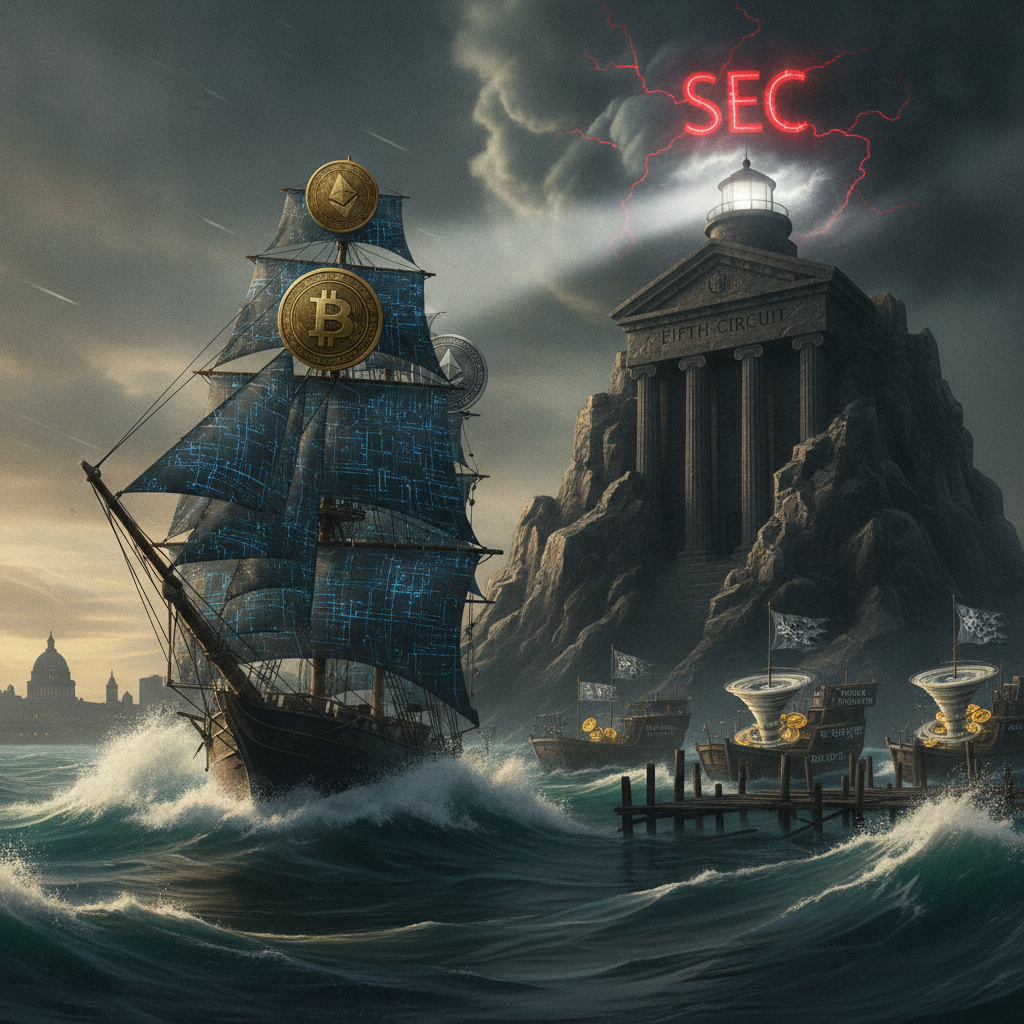
Fifth Circuit Narrows SEC’s Crypto Reach, Giving Exchanges Breathing Room

Wellermen Image Court Deals Fresh Blow to SEC’s Crypto Crackdown

Fifth Circuit judges just clipped the SEC’s wings in a major crypto case. The ruling narrows how far the agency can stretch securities law and hands exchanges and token projects breathing room they haven’t had in years. Markets are already pricing in lower enforcement risk.

The lawsuit began when the SEC accused a crypto trading platform of selling unregistered securities through its staking and token programs. Regulators argued these products met the classic Howey test for investment contracts. The exchange fought back, claiming its offerings were commodities or utilities, not securities, and that the agency was rewriting rules without Congress. After losing at the district level, the platform appealed to the Fifth Circuit, where judges had already shown skepticism toward broad federal power grabs.

On appeal the court zeroed in on one question: whether marketing a token with vague promises of future value automatically turns it into a security. The three-judge panel ruled that mere profit expectations tied to a network’s overall success do not equal the kind of common-enterprise investment the securities laws require. Two of the three judges sided with the exchange, holding that the SEC must prove buyers were led to expect profits derived solely from the issuer’s efforts, not from general market speculation or decentralized governance. The third judge dissented, warning that the majority had created an enforcement gap.

The SEC lost its bid to treat the tokens as securities and must now restart parts of its case under tighter standards. The platform scores a tactical win that could force the agency to drop or narrow several parallel actions. Exchanges gain leverage in settlement talks, and projects that avoided explicit profit pitches feel newly insulated.

The decision chips away at the SEC’s preferred theory that almost any token sale equals an investment contract. If other circuits follow, the agency’s authority to police spot trading and staking shrinks while the CFTC’s commodity jurisdiction expands. Traders may see thinner compliance costs and more DeFi experimentation, yet stablecoin issuers still face classification risk if marketing materials suggest managed yields. Decentralized protocols win a short-term shield, but centralized exchanges must keep proving their products are not packaged as managed investments.

Exchanges should treat this as a tactical reprieve, not a permanent shield—regulators rarely quit after one loss.

Bitcoin: Noah Doe-Linked Reawakens as 2011 Casascius Cashes Out

Onchain records indicate that another Casascius physical bitcoin has been redeemed, this time from an address first created on November 1, 2011. The spend appears to connect, via transaction history, to a previously dormant wallet referenced in the New York Supreme Court case Noah Doe v. John Does 1–39,069, adding a new development to ongoing scrutiny of early-era bitcoin movements.

Another Casascius Coin Redeemed

Blockchain data shows the redemption of a bitcoin associated with a Casascius physical coin minted in the early 2010s. Redeeming, often called “peeling,” occurs when the private key hidden beneath a coin’s tamper-evident hologram is used to move the onchain funds, rendering the physical token no longer loaded.

The source address tied to this redemption was originally created on November 1, 2011, placing it squarely in bitcoin’s formative years. While the exact denomination of the redeemed Casascius coin was not disclosed, the onchain movement underscores the ongoing trend of long-dormant coins awakening.

Background: What Are Casascius Bitcoins?

Casascius coins are physical bitcoins created between 2011 and 2013 by Mike Caldwell. Each coin was loaded with a specific amount of BTC secured by a private key embedded under a hologram. When the hologram is removed and the BTC is spent onchain, the coin is considered redeemed. Production ceased in 2013 following regulatory pressure, and remaining unredeemed coins are tracked closely by collectors and blockchain observers.

Connection to the ‘Noah Doe’ Case

The redemption’s transaction history appears to trace back to a dormant wallet cited in the New York Supreme Court matter Noah Doe v. John Does 1–39,069. That case, which names a large number of unknown defendants, has referenced multiple cryptocurrency addresses in its filings. The observed onchain link does not by itself establish ownership or control, but it places the newly active funds within a network of addresses previously noted in court records.

Why It Matters

Movements from early-era wallets are closely watched for their historical and market significance. Each redemption reduces the count of still-loaded Casascius coins while adding to the circulating pool of BTC originating from the 2011–2013 period. The apparent tie-in to a wallet cited in a major court case further highlights how legacy addresses can intersect with ongoing legal and investigative efforts in the cryptocurrency space.

SEC Appoints New Enforcement Chief as Crypto Crackdown Fades

Wellermen Image

SEC Taps New Enforcement Chief as Crypto Cases Quietly Fade

David Woodcock is taking over as the SEC’s new enforcement chief at a moment when several high-profile crypto cases appear to be quietly disappearing. The timing has raised eyebrows on Capitol Hill, where senators are demanding answers about why lawsuits against Justin Sun and other crypto firms were suddenly dropped.

Woodcock’s appointment comes as the agency faces internal questions over the abrupt exit of his predecessor and the unexplained decision to walk away from enforcement actions that once looked like cornerstones of Chair Gary Gensler’s crypto crackdown. Lawmakers want to know whether political pressure, shifting priorities, or simple legal weakness drove the reversals.

The move signals a potential softening in the SEC’s aggressive posture toward digital assets, even as the agency continues to claim broad authority over tokens and trading platforms.

What This Means for Crypto

The enforcement division sets the tone for how aggressively the SEC pursues crypto projects and exchanges. A new chief often brings new priorities, and Woodcock’s arrival suggests the agency may be stepping back from the courtroom battles that defined the last two years.

For traders and investors, this reduces immediate regulatory overhang on tokens previously targeted in lawsuits. Builders gain breathing room to ship products without the constant threat of enforcement actions that could kill projects overnight.

Long-term, however, the underlying legal questions remain unresolved. Without clear legislation, future enforcement chiefs could easily reverse course again.

Market Impact and Next Moves

Markets are likely to read this as mildly bullish in the short term, especially for tokens and platforms that were under active investigation. Lower enforcement risk tends to lift sentiment and reduce selling pressure tied to regulatory headlines.

The biggest risk is uncertainty. If senators push back hard or force more aggressive action, the SEC could swing back toward lawsuits just as quickly. Liquidity in smaller tokens remains fragile if enforcement fears return.

Opportunities lie in projects that can demonstrate real utility and compliance readiness before any new enforcement wave begins. Those with strong fundamentals and clean legal structures are best positioned to benefit from any extended regulatory pause.

Watch how Woodcock’s first major decisions play out — they will reveal whether this is a genuine shift or just a temporary lull.

NY Appeals Court Upholds $12M Fraud Verdict Against Tauber in Regal Case

Wellermen Image Regal Ruling Slams Trader With $12 Million Verdict

A New York appeals court just upheld a massive fraud judgment against commodities trader Tauber, confirming that he misled investors and must pay Regal Commodities the full amount. The decision tightens the net around deceptive trading practices and signals that courts will no longer tolerate gray-area tactics that once thrived in lightly regulated crypto and commodities markets. For traders and platforms watching from the sidelines, the message is unmistakable: misrepresentations carry real financial consequences.

The case began when Regal accused Tauber of orchestrating sham trades that masked massive losses and lured fresh capital under false pretenses. Tauber appealed the trial court’s award, arguing the evidence was insufficient and the damages inflated. The Appellate Division, Second Department, reviewed the record and rejected every argument, finding clear proof of intent to deceive and measurable harm to Regal’s portfolio. Judges held that Tauber’s conduct crossed the line from aggressive trading into outright fraud, leaving no room for reinterpretation on appeal.

The ruling hands Regal a clean victory and forces Tauber to satisfy the judgment immediately, while other counterparties gain precedent to pursue similar claims. Platforms and funds that previously viewed New York as a jurisdiction tolerant of creative structuring now face heightened litigation risk. Regulators gain an implicit assist; although the case is purely private, the affirmed findings of deceptive dealing provide fresh ammunition for enforcement staff scanning for parallel violations.

In practical terms, any token, derivative, or yield product sold with inflated performance claims or hidden counterparty risk now carries extra legal weight in New York courts. Exchanges listing such products must tighten disclosures, and DeFi protocols relying on anonymous treasuries or off-chain assurances face greater exposure if investors later claim misrepresentation. The decision does not expand SEC jurisdiction directly, yet it reinforces the broader principle that economic substance—not clever documentation—determines liability.

Traders who still believe “not illegal” equals “court-proof” just got a costly reality check.

Seventh Circuit Slaps CFTC, Forcing Narrower Discovery in Kraft Probe

Wellermen Image Court Slaps CFTC for Overreaching in Kraft Probe

The Seventh Circuit just told the Commodity Futures Trading Commission it cannot simply demand every document under the sun without a fight. In a sharply worded ruling, the court denied the agency’s emergency petition for a writ of mandamus, leaving a lower-court protective order intact and forcing regulators to justify broad document sweeps in enforcement cases. The decision lands at a moment when crypto traders and exchanges are already bracing for tighter oversight, and it signals that courts may no longer rubber-stamp aggressive discovery requests from financial watchdogs.

The dispute began when the CFTC launched an investigation into Kraft and its affiliate Mondelēz, suspecting the food giants manipulated wheat futures. During discovery, the companies asked the district court to shield sensitive commercial data. The judge agreed, issuing a protective order that limited how much raw information the agency could scoop up. Furious, the CFTC raced to the Seventh Circuit, arguing the order would cripple its probe and that only mandamus—an extraordinary remedy—could fix the problem before trial.

Writing for the panel, the appellate judges found the CFTC failed the steep legal test for mandamus. They ruled that ordinary appeal rights after final judgment offered enough protection and that the agency had not shown “irreparable harm” from the protective order. The court also noted the companies’ privacy interests were legitimate, and judges retain discretion to balance enforcement needs against those interests. In short, the CFTC lost its bid to bypass normal procedures and must now live with narrower access to Kraft’s records.

That ruling translates into a clear message: regulators cannot treat every enforcement action as a fishing expedition. Courts will demand evidence that broad document demands are necessary, not merely convenient. For crypto firms facing parallel inquiries from the CFTC and SEC, the precedent offers a ready-made argument to push back against sweeping subpoenas and endless data requests.

The decision shifts the balance of power toward targets of investigations and may slow the agencies’ ability to build cases on the fly. In crypto markets already jittery over enforcement clarity, any sign that regulators can be checked in court tends to lift risk appetite; traders may interpret this as a small but tangible brake on unchecked authority. Exchanges and DeFi protocols could cite the ruling when negotiating narrower compliance scopes, while stablecoin issuers and token projects gain leverage to challenge expansive record demands.

Watchdogs just learned the hard way that federal judges still hold the gavel.

Court Refuses MDL; Crypto Cases Remain Split Across Three Districts

Wellermen Image COURT SNUBS ILLINOIS BID TO POOL CRYPTO CASES

Three scattered lawsuits over digital-asset trading platforms just got harder to corral. A federal judicial panel refused to fold the actions into a single courtroom in Chicago, leaving each case to grind forward on its own timetable. The ruling keeps pressure on exchanges and token issuers while preserving the SEC’s ability to press separate enforcement theories in different districts.

The trouble began when plaintiff Anthony Motto asked the Judicial Panel on Multidistrict Litigation to gather Greene, now in Chicago’s federal court, with parallel suits running in Los Angeles and Philadelphia. Motto argued that common questions about whether certain tokens count as unregistered securities justified one judge handling all discovery and motions. Opposing parties, including the platforms themselves, countered that the cases involve distinct products, marketing claims, and state-law wrinkles best left with the judges already assigned.

In a short order signed by Chair Sarah S. Vance, the Panel declined to create an MDL. The judges found that, despite some overlap on the “investment contract” question, factual differences and the limited number of actions did not outweigh the inconvenience of uprooting two dockets. No new steering committee or consolidated calendar will emerge; each court keeps full control over its schedule, evidence rules, and potential settlement talks.

The decision means plaintiffs cannot pool resources or force uniform rulings on whether the tokens at issue are securities under the Howey test. Defense teams avoid the heavier lift of nationwide class discovery, yet they still face three separate fronts of attack. Regulators watching the litigation will continue to shop districts they view as sympathetic, while traders and liquidity providers must price in the risk that an adverse finding in any one case could ripple through pricing models.

For markets, the lack of centralization keeps uncertainty alive: exchanges cannot bank on a single precedent to shape compliance programs, DeFi protocols must still hedge against piecemeal enforcement, and stablecoin issuers see no shortcut around proving their tokens are commodities rather than securities. The fragmented approach favors plaintiffs willing to forum-shop and raises legal spend for every defendant.

Decentralized platforms just bought time, but they did not buy clarity—three courts, three sets of eyes, and three chances for the SEC to land a precedent that could redefine how tokens trade tomorrow.

– Raydium AMM Exploit: $1.34M Lost — What Happened – Raydium DEX AMM Exploit Sparks $1.34M Loss — How It Happened – Raydium AMM Exploit: $1.34M Lost, What Went Wrong – What Went Wrong in Raydium AMM Exploit ($1.34M) – Raydium AMM Exploit: $1.34M Lost — How It Unfolded

Raydium, a decentralized exchange on the Solana blockchain, disclosed a roughly $1.34 million exploit tied to its retired AMM V3 program, with the attacker draining funds from multiple liquidity pools. The protocol said current programs remain unaffected.

Exploit Targeted Retired AMM V3

Raydium said Wednesday that an attacker siphoned assets from legacy AMM V3 pools involving RAY-SOL, USDC-RAY, and SRM-RAY. The protocol estimated losses at approximately $1.34 million, including:

  • About 150,000 RAY (Raydium’s native token)
  • Approximately 5,600 SOL
  • Nearly 900,000 USDC (Circle’s U.S. dollar stablecoin)

The exchange emphasized that the affected AMM V3 program was phased out in 2021 and is no longer accessible through Raydium’s current user interface, though the legacy contracts remain on-chain.

Root Cause: LP Mint Validation Flaw

Raydium attributed the incident to insufficient validation of liquidity provider (LP) mints in the legacy AMM V3 program. According to the team, the mechanism failed to properly verify the LP mint address, allowing an attacker to create a new mint and use it as the LP token. This bypassed proportion checks intended to control how assets are accounted for in Raydium’s pools.

LP tokens represent a user’s share of a liquidity pool in automated market makers. Proper validation ensures that only authorized LP mints can interact with the pool under predefined rules.

Funds Bridged and Laundered Across Chains

Blockchain security firm PeckShield said the attacker’s activity was initially funded via KuCoin before funds were bridged from Solana to Ethereum. PeckShield reported that about 810 ETH was sent to Tornado Cash, a privacy mixer, and roughly 7 ETH was moved to FixedFloat, describing the transfers as part of an active laundering effort.

Raydium’s Response

Raydium said its current programs were not impacted by the exploit and noted that core contributors are conducting security reviews across all mainnet programs. The protocol reiterated that the vulnerability was confined to the retired AMM V3 implementation.

Zcash Surges 30% on Ceasefire Hype, Yet History Warns of a Trap

Wellermen Image

Zcash Pops 30% on Ceasefire Hopes, But History Warns of Trap

Zcash surged as much as 30% after reports of a US–Iran ceasefire sparked a short-lived risk-on wave across crypto. The move mirrored sharp rebounds ZEC posted during the 2021 bear market, when brief relief rallies quickly reversed into deeper losses.

The price jump came on thin volume and coincided with broader altcoin buying rather than any fresh Zcash-specific catalyst. On-chain data showed limited new accumulation, while futures open interest remained modest, suggesting the rally was driven more by short covering than conviction buying.

Traders who bought the pop now face the same pattern that punished late bulls in prior cycles: rapid retracement once macro sentiment fades. A 40% pullback from current levels would bring ZEC back toward its pre-rally range, wiping out most of the ceasefire-driven gains.

What This Means for Crypto

Zcash remains a privacy-focused coin whose value proposition has struggled to attract sustained institutional flows. Without clear regulatory tailwinds or meaningful adoption growth, price moves tend to track broader risk sentiment rather than project fundamentals.

For traders, the lesson is straightforward: relief rallies in bearish macro regimes often serve as exit liquidity. Long-term holders betting on privacy narratives should watch whether volume and developer activity improve before treating this move as the start of a new uptrend.

Market Impact and Next Moves

Short-term sentiment looks mixed at best. The quick 30% spike may have flushed out some shorts, but the absence of follow-through volume leaves the door open to another leg lower if macro risk appetite fades again.

Key risks include thin liquidity that can amplify downside moves and the possibility of renewed geopolitical headlines reversing the ceasefire narrative overnight. Leverage buildup on the way up could also trigger cascading liquidations if price slips back below recent support.

Opportunities remain limited to nimble swing trades around key levels rather than directional bets, unless on-chain metrics begin showing consistent accumulation from larger holders.

History suggests treating this ZEC pop as a potential bull trap rather than the start of a sustained recovery.

Crypto Wins: Fifth Circuit Narrows SEC’s Reach—Most Tokens Aren’t Securities

Wellermen Image Court Blocks SEC From Treating Most Crypto Tokens as Securities

Fifth Circuit ruling guts broad enforcement theory against digital assets. Decision forces SEC to prove tokens are investment contracts before labeling them securities. Markets breathe as regulatory drag lifts for thousands of tokens.

The lawsuit began when crypto firms challenged the SEC’s sweeping assertion that nearly every token sold after an initial distribution automatically qualifies as a security under federal law. Lower courts had split on whether secondary-market sales trigger the same disclosure rules as traditional stock offerings. The Fifth Circuit agreed to hear the appeal after traders and exchanges warned that unchecked SEC power would freeze liquidity and push innovation offshore.

Judges ruled that tokens lack the hallmarks of an investment contract unless promoters promise ongoing profits derived from their own efforts. The opinion rejected the agency’s “ecosystem” theory that any token benefiting from developer activity is a security by default. Plaintiffs prevailed on the key issue; the SEC lost the ability to bootstrap enforcement actions from prior sales alone. Secondary trading platforms and DeFi protocols gain immediate breathing room while the agency must now build narrower cases around specific promises rather than blanket classification.

The decision narrows the SEC’s statutory reach without eliminating it. Tokens that function purely as utilities or currencies sit outside securities law unless marketing materials create reasonable profit expectations tied to third-party labor. This resets the compliance baseline for exchanges and wallet providers that had been bracing for mass delistings or registration mandates.

Authority over digital commodities tilts toward the CFTC where tokens lack investment-contract traits, easing pressure on decentralized protocols that never raised capital through promoter sales. Stablecoin issuers still face separate banking scrutiny, yet the ruling removes one layer of overlapping securities risk. Traders see reduced threat of retroactive enforcement, while centralized exchanges gain leverage in listing negotiations knowing the SEC’s prior leverage has weakened.

The market just won a structural edge, but only until Congress or another circuit redraws the line.

×